Ruth Gordon: Intention
“The intention is interior, mental, constant. The world will turn out right. We will work, and we will work well. We will be present for others."

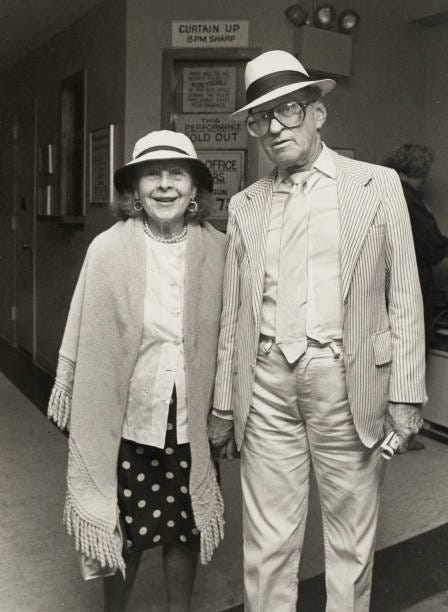
In 1998 I asked Garson Kanin to clarify some things Ruth Gordon had told me in 1984. I was interested to find out what she meant by intention.
In that initial phone call I had with Ruth, she had told me this:
To make anything work, I braced up my intentions. I intend to make it work. Intention has been going for me a long time, I got it started in 1912, but what counts is what you decide on today. Decide to have intention. I’m a believer in today.
Do you believe you get there on American Airlines or do you believe you get there on intention? American Airlines is good, so is TWA, so are the friendly skies of United, so is a Lincoln Continental, so is a Chevy, so is walking, but for getting there, count on intention.
Intend it.
Notify your built-in confidence.
Work on it.
Do not face the facts.
Keep your bowels moving.
Walk, think.
Where are you? Maybe you’re there.
You shouldn’t be cocky, but you also shouldn’t be surprised when you succeed. Part of having intention is having the belief that you belong and that you’re doing good work, so when someone pats you on the head and tells you you’re good, you shouldn’t duck your head and pull on a hair shirt. You shouldn’t be amazed that you got it right: You’ve worked your whole life to get it right, to get every damn thing right. Why be surprised?
Better to be grateful. And I am. The right deal came down the right road with the right people several times for me, and I got to be good. That makes me happy and it makes me grateful, but it doesn’t surprise me. It’s what I was working toward!
Garson nodded when I read these words to him. “That’s Ruth,” he said. “Fully.”
I wanted to know more. By 1996 intention had various meanings. It was a word that was employed toward different means. I asked Garson if Ruth used intention as others were then using creative visualization as espoused by Shakti Gawain. Later, there would be dream boards, wishes cast, entire sessions of mediation devoted to getting what one wanted.
“I don’t know who that person is—Shakti. I never saw Ruth lighting candles or in a lotus position, not that either of us took any fault with those things or people who utilized those things. Ruth was a great respecter of other people and the methods by which they got where they got. Ruth never sought one goal: She never had a plan that included getting a certain part or a certain award or a certain amount of money. Ruth’s goal was to always be and do her best, which for her included working hard and well; helping others get a leg up; being positive about all things. That was her foundation, so to speak, and from that arose the parts, and the awards, and the money.
“When Ruth died, Julie Harris sent me such a lovely letter. I’m thinking of this now because Julie was quoted recently in a piece where she admonished another actress for saying something negative about the theatre. Julie recoiled and told her never to say such a thing. Well, in this letter, Julie states that she learned this from Ruth. I cannot imagine Julie being too negative, but even a little bit of negative was too much for Ruth. Julie wrote that she was bemoaning some aspect of her career, and Ruth told her she might as well be eating rat poison: Julie had infected her person. It woke Julie up. Julie once told a reporter who was praising her talent that if she had tits, she could rule the world, and Ruth told her later Lissen, I know an actress over on 32nd Street with great tits, and she can’t get ARRESTED!”
JG: It’s not the the tits…
“No, it’s not the tits, and if Julie had thought of getting her breasts enlarged, Ruth told her, it would be a violation of her body and the pact she had with audiences. Audiences recognized her greatness, even if she didn’t, and they loved her just as she was. Ruth and Helen Hayes once spoke of how Marlene Dietrich would make plans to see them, and then cancel them. She ultimately admitted that she didn’t feel she looked good enough for a visit. Neither Helen nor Ruth gave a damn about how she looked: They wanted to see a friend, but Marlene felt that her value, her worth, was based on her beauty, and if she thought she had lost that, well…”
JG: It’s like Marian [Seldes] telling us—all of us—to not put things in our DNA. The thoughts become manifest.
“Exactly. I think this is now considered radical or new-age or whatever they’re calling it, but that thought has been around a long time, and Ruth appeared to have been born thinking that way. Things are going to happen for us. Never just her. Everyone. All boats shall rise. I can recall times when Ruth would read of a producer needing someone for a particular part, and she would get on the phone and call up several women she knew, urging them to get over to that office. I would ask her why she was doing that. Wasn’t she reading for the same part? Yes, she would say, but everyone should be seen for it. Ruth would go to an audition and know that the part wasn’t right for her; that she couldn’t get the hose or the shoes on, as she put it. However, she was in the room. She was seen. She had fun. Those relationships would serve her one way or another. I never heard her complain about anything unless she saw someone being mistreated.
“The intention is interior, mental, constant. The world will turn out right. We will work, and we will work well. We will be present for others. That is the intention Ruth and I talked about all the time. Everything arose from that.”