Only John Lithgow Could Get Away With This
He’s terrific as Roald Dahl in “Giant,” a play at the center of the antisemitism vs anti-Zionism debate.

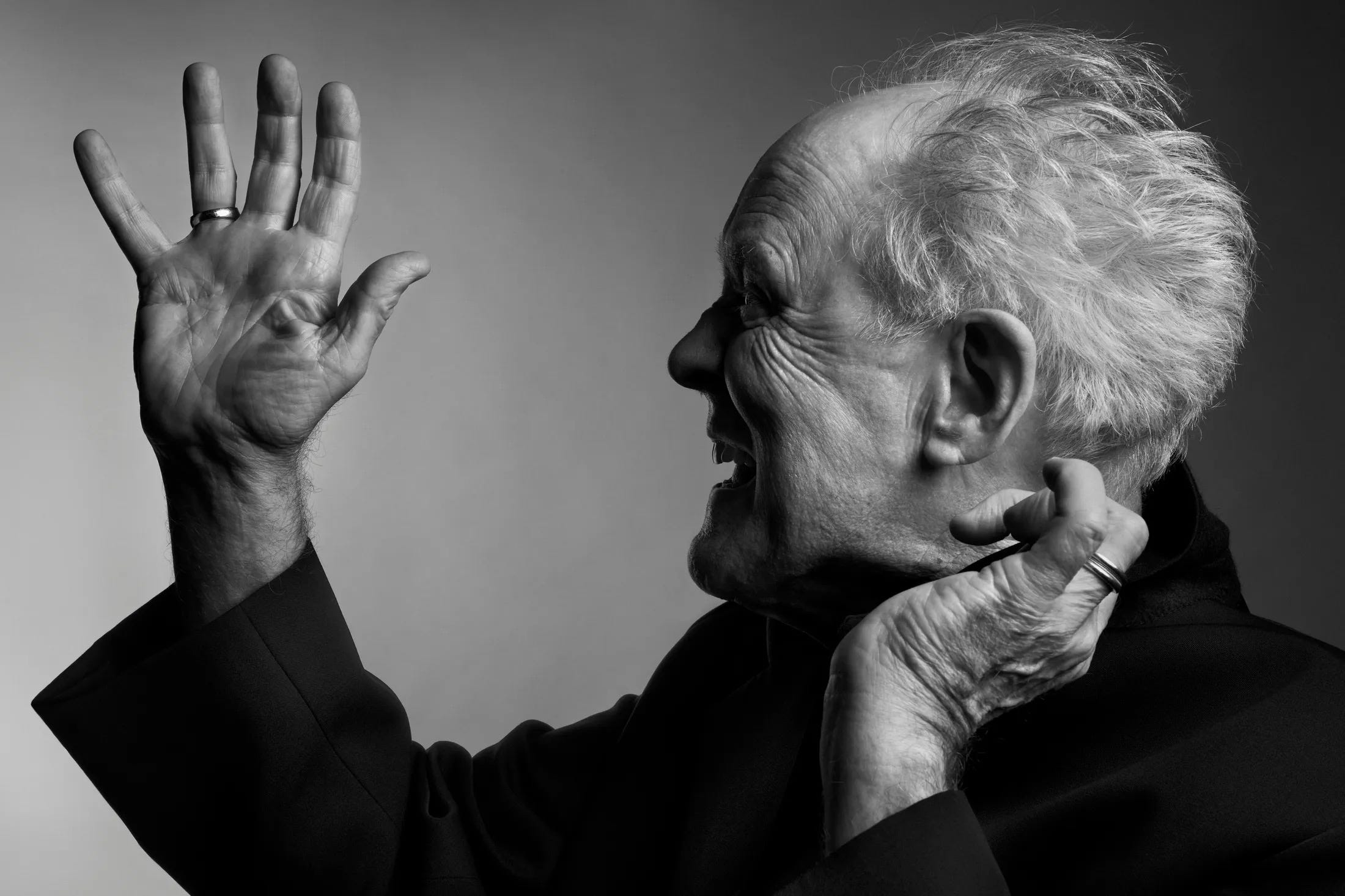
By Rebecca Alter for New York magazine
Images by Mark Seliger
On a sunny April Thursday on the Upper West Side, John Lithgow took me through the stage door of the David H. Koch Theater, where the New York City Ballet is rehearsing his friend Christopher Wheeldon’s Continuum. With his gray tweed flatcap under his arm, Lithgow settled into a chair and scanned the room, watching pairs of dancers fold themselves into impossible knots, rapt with their “onerous shapes.” “They just thrill me to watch,” he leaned over to tell me between sections. “Actors do about 10 percent of what dancers do.” He paraphrased Noël Coward: “The essence of acting is to learn your lines and don’t bump into the furniture.”
At six-three and 80 years old, Lithgow could never be mistaken for a dancer, but he had acted with the NYCB a year prior, when he and Wheeldon brought their take on Camille Saint-Saëns’s Carnival of the Animals suite to the city. Few actors veer so wildly between highbrow and low entertainment. Lithgow graduated from Harvard magna cum laude and studied at the London Academy of Music and Dramatic Art on a Fulbright, yet he used this training to play a diminutive bad guy in Shrek whose name sounds like “fuckwad” in Lithgow’s transatlantic inflection. He has an incredible capacity to play both overgrown innocents (the guileless suitor in Terms of Endearment) and repressed, perverted psychopaths (Dexter’s Trinity Killer). He can ramp up the approachable charm (30 Rock, the dad in Harry and the Hendersons) or completely void himself of it (the cruel, puritanical preacher in Footloose). He has the range, though he’s not a chameleon; it’s more that he has the room in his big, unmistakable frame to house such vast extremes. In recent years, his career has stayed as much of a grab bag as ever. He played the chilly, espresso-sipping Cardinal Tremblay in 2024’s Conclave, a creep tormenting Geoffrey Rush with a hand puppet in The Rule of Jenny Pen, and an artsy gay grandfather bonding with his nonbinary grandchild in last year’s Australian indie Jimpa.
In his latest role as Roald Dahl in Giant, which earned him his seventh Tony nomination, Lithgow hones these disparate aspects of himself into precisely targeted weapons, deploying them at the Music Box Theatre to explosive effect. A first-time playwriting effort from veteran theater director Mark Rosenblatt, the six-person chamber play, directed by the London Theatre Company’s Nicholas Hytner, depicts an imagined afternoon in Dahl’s life as the British children’s author prepares for the 1983 release of The Witches. Representatives of Dahl’s publishing house have descended upon Gipsy House, his mid-renovation wrecking site of a Buckinghamshire home, to persuade him to issue an apology for his review of journalists Tony Clifton and Catherine Leroy’s book God Cried, which documents the Israeli siege of Beirut in 1982. Critics are calling Dahl’s language antisemitic, a claim that ignites an obstinance in the old author that builds from cheekily contrarian to rageful and conspiratorial over the play’s two acts. Elliot Levey plays Dahl’s clever, shit-eating U.K. sales director and publisher, Tom Maschler, and Aya Cash, who also received a Tony nomination, plays his American junior, Jessie Stone, a fictional creation of Rosenblatt’s. Tom is fluent in Dahl’s style of private-schoolboy banter, which the author uses to downplay his faults and dig at others’; Tom knows when to rally the ball back and when to give Dahl a point to keep his ego in check. Jessie is the alien Manhattanite in the room; her emotional frankness in dealing with Dahl provokes him to pounce on her. He appears genuinely impassioned by the plight of Lebanese children — his fiancée, Felicity “Liccy” Crosland (Rachael Stirling), tells Jessie, “Lebanon broke his heart. Truly” — but the show culminates in the hate-speech equivalent of an 11-o’clock number: Dahl’s antisemitic comments to the New Statesman, dramatically recited verbatim by Lithgow, among them that “even a stinker like Hitler didn’t just pick on [Jews] for no reason.”
After the rehearsal, Lithgow guided us across the street to a Mexican restaurant for lunch. Only minutes after he folded his long legs into a corner booth, an older woman approached our table. “I’d just like to thank you immensely for your work,” she said. “I’ve seen you many times.” Lithgow asked if she’d seen Giant. “Yes, once in London, and once here. I also saw you at Temple Emanu-El being interviewed.”
“My God, you are a fan,” said Lithgow, playing the part of spotted celebrity. (I get the sense he wanted to sit facing outward in the booth because he relishes these interactions.) The woman lowered her tone. “And particularly in this day and age with everything going on, as a Jewish person, it’s frightening.”
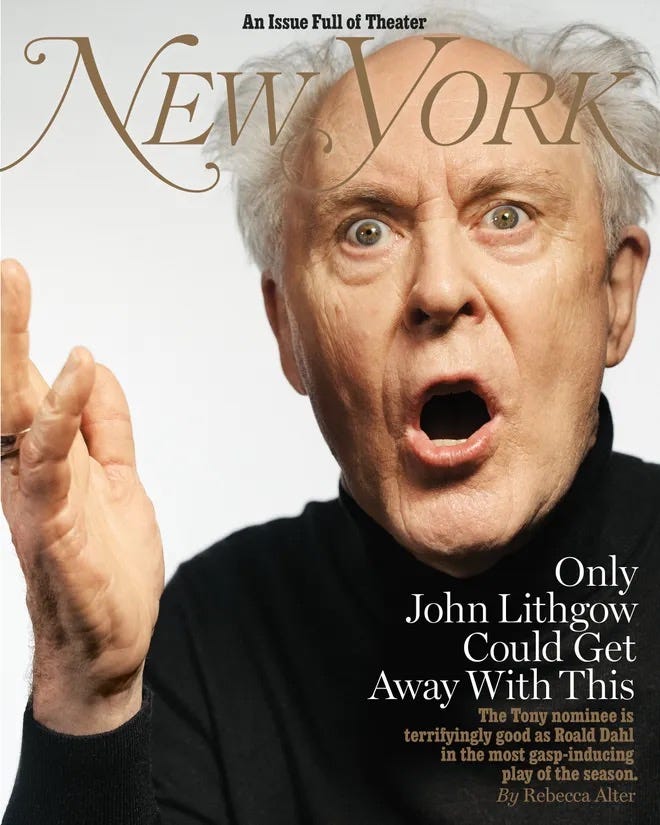
I told him I imagine it’s unavoidable for him to step out on the Upper West Side and not have these kinds of interactions with fans. “If none of it happened, I would sulk,” he said. Giant comes at a time when the conflation of anti-Zionism with antisemitism has been politicized and used to detain students, shut down legal protests, and justify sending funds and weapons to Israel. In Act One, it is undeniably riveting to see an A-list actor on a Broadway stage articulate the political frustrations progressive Jews have been experiencing for years: the anguish over the ethnic cleansing being done in our names; the alienation from the majority of mainstream Jewish organizations, which continue to treat support for this nation-state as a compulsory central tenet of their values and fundraising efforts; and the trap of trying to distinguish antisemitism from anti-Zionism when so many prominent Jewish leaders and U.S. government officials alike insist they are one and the same. But Giant puts most of these ideas in the mouth of a monster. In this way, the show structurally positions a centuries-old, empirical, irrational antisemitism as the underlying motivator of non-Jews who speak out against Israel. The show culminates in the character’s “mask off” moment, as Dahl picks up the phone and proceeds to shoot his legacy in the foot by unloading an antisemitic rant to a journalist, on the record.
It is impossible to imagine the history of Broadway without Jewish playwrights, composers, and producers, and in recent years, we have seen a spate of productions with historical and contemporary themes of antisemitism, including Parade, Leopoldstadt, and Harmony. Off Broadway, shows like The Ally and the upcoming Birthright put conversations about Israel center stage in drawing-room-play formats similar to that of Giant, while more provocative works like Slam Frank and Jewish Plot push back against that very centering in light of the untold stories of thousands of Palestinians terrorized in the name of Jewish safety.
These are waters Lithgow wades into naturally. A role like Dahl grants him the opportunity to explore the tensions and contradictions that can make up one man. “I think it’s very important to put that out in front of people, dramatizing the secret arguments that people are scared to have,” he told me. (The fact that he’s playing a bigoted British children’s author the same year he will star as Dumbledore in HBO’s new Harry Potter television adaptation adds a metatextual layer to his performance.) Lithgow believes discomfort is what makes the play compelling: “My Roald Dahl is a broken clock who is correct twice a day. He says things that you reflexively agree with, and then he undermines it by betraying his own cruel nature.”
In the review that landed Dahl in hot water, written for the monthly magazine Literary Review, whose publisher was a Palestinian named Naim Attallah, he admonished the U.S. for funding Israel’s military efforts; condemned the expansion of Jewish settlements in the West Bank; explained the horrors of the cluster bomb, the phosphorous bomb, and the penetration bomb; and compared Israel’s then–prime minister, Menachem Begin, to Hitler. Dahl also extended the Third Reich comparisons to Jews as “a race of people,” criticizing their majority support for Israel and asking, “Do they have a conscience? And do they, I wonder, have the guts? Or must Israel, like Germany, be brought to her knees before she learns how to behave in this world?” In a subsequent interview with the New Statesman, he went on the record with even more bigoted, explicitly antisemitic language. Giant centers on Dahl’s publisher’s efforts to prevent the book review from affecting sales of The Witches, but in reality Dahl’s career wasn’t affected by either review or interview. The Witches went on to win numerous awards for children’s literature in 1983, and he was offered (and turned down) the OBE in 1986.
Dahl’s creations are ingrained in the U.K.’s collective childhood imagination. A 2023 BBC poll of the “100 Greatest Children’s Books of All Time” lists six by Dahl, more than by any other author on the list. Dahl populated his stories with comically cruel and grotesque adults, the kinds of villains who leave indelible impressions on young readers, in a way the character of Tom Maschler, who escaped Germany via Kindertransport as a child, expresses beautifully in a monologue in the show: “In his books, he picks a glorious, playful path through the chaos of childhood. It’s the rarest of gifts. To show its cruelty but take you out the other side. And the more kids feel guided by his books, the more boldly they’ll read as adults and rise above the narrow crap their parents told them to sit with braver minds in richer worlds.”
Rosenblatt had never written a play when he began working on what would become Giant in 2018. The now-48-year-old director grew up loving Dahl’s work and later read Dahl’s books to his young son when he started mulling the idea. “I found myself going, I have a particular personal relationship with this man’s creative work, and I also know that this man, whose work I love, may not have liked me as a person.” Considering how he’s depicted in Giant, Rosenblatt added, “he certainly wouldn’t love me now.” Dahl’s review of God Cried, he thought, was a “perfect mirror” of how such prejudice can seep into and infect valid political discourse.
He took the idea to Hytner, hoping the director could find a playwright to realize the piece. Hytner said Rosenblatt should be the one to write it.
Lithgow first worked with Hytner on The Sweet Smell of Success in 2002. It was Lithgow’s first Broadway musical, it won him a Tony (the show’s only one, out of seven nominations), and it was a flop. “It opened six months after 9/11, and New York City did not want to see a dark musical,” Lithgow said. But the collaboration sparked a long friendship with Hytner, who emailed Lithgow an early version of the script for Giant in 2023. “It was overlong and very expository, a lot of lesson teaching about the history of Israel and Palestine. But it had amazing dialogue in it,” Lithgow said. He admits he didn’t know much about Dahl or his work until he joined this project besides taking part in a reading of one of his “proper grown-up short stories” at the Getty in 2006. He suspects his daughter, who was a bookworm as a child, probably read her fair share of Dahl. “My son, not so much,” he said. “He was much more the athlete and the rascal.”
He was drawn to the layers the role allowed him: charm, pompousness, anger, hate. To ground the character, to find the relatable, likable elements in him, he asked his friend and Requiem for a Heavyweight co-star Maria Tucci about Dahl. She knew him because her late husband, Robert Gottlieb, was “the man who fired Roald Dahl from Knopf.” She told Lithgow how “he played with children at a dinner at Gipsy House where there were kids underfoot. He would spend the entire time with the kids. He really believed passionately in writing well for children, entertaining children, educating them well.” Seeing Dahl after hours of such playing, “she described his face as being completely spent and exhausted,” Lithgow said. He wove that physicality into his performance in a scene where Dahl is reminded of his late daughter.
That human side of Dahl, and all his contradictions, was Lithgow’s “way in” to the role. “My whole philosophy of life is prejudice comes out of damage, and this feeling of injustice,” he said. “The world has done me dirt, and I’m going to get back at them. Hatred of the other.” Born in Wales to Norwegian parents in 1916, Dahl wrote extensively about his youth at abusive public schools and the injuries he incurred in the Royal Air Force in World War II. Giant addresses the personal tragedies that left Dahl broken: the devastating death of his daughter when she was 7 and the accident that left his infant son with severe brain damage. “You take all those things together, and here’s a man who’s angry at the whole fucking barrel,” Lithgow said. “And what happens? Look for scapegoats. Who has it in for me?”
In September 2023, Lithgow signed on to collaborate on a workshop of the script in London, which led to the Royal Court Theatre’s agreeing to stage it Off West End. The date was October 5, 2023. After October 7, Lithgow immediately wrote to Rosenblatt and Hytner, asking, “Jesus, can we still do this play? This is so volatile right now.” But Hytner believed there was no better time to stage it. Rosenblatt called this “the biggest obstacle, which was this atmosphere into which this play will be performed for the first time. It’s very sensitive, and very raw, and there is a lot of cultural and societal anger around these issues.” Rosenblatt admired Lithgow’s courage in committing himself so fully to this play at this moment, saying, “He’s decided to step into a political conversation that is complicated, at a time in his life where he doesn’t need to do that.” The show opened in September 2024 to positive reviews and raves for Lithgow specifically, and it won Olivier Awards for Lithgow, Levey, and Rosenblatt. The following April, it transferred to the West End, where stars like Mick Jagger and Tom Stoppard would come backstage. “Everybody would get plastered on cheap rosé and then John would come and join us,” Levey remembered.
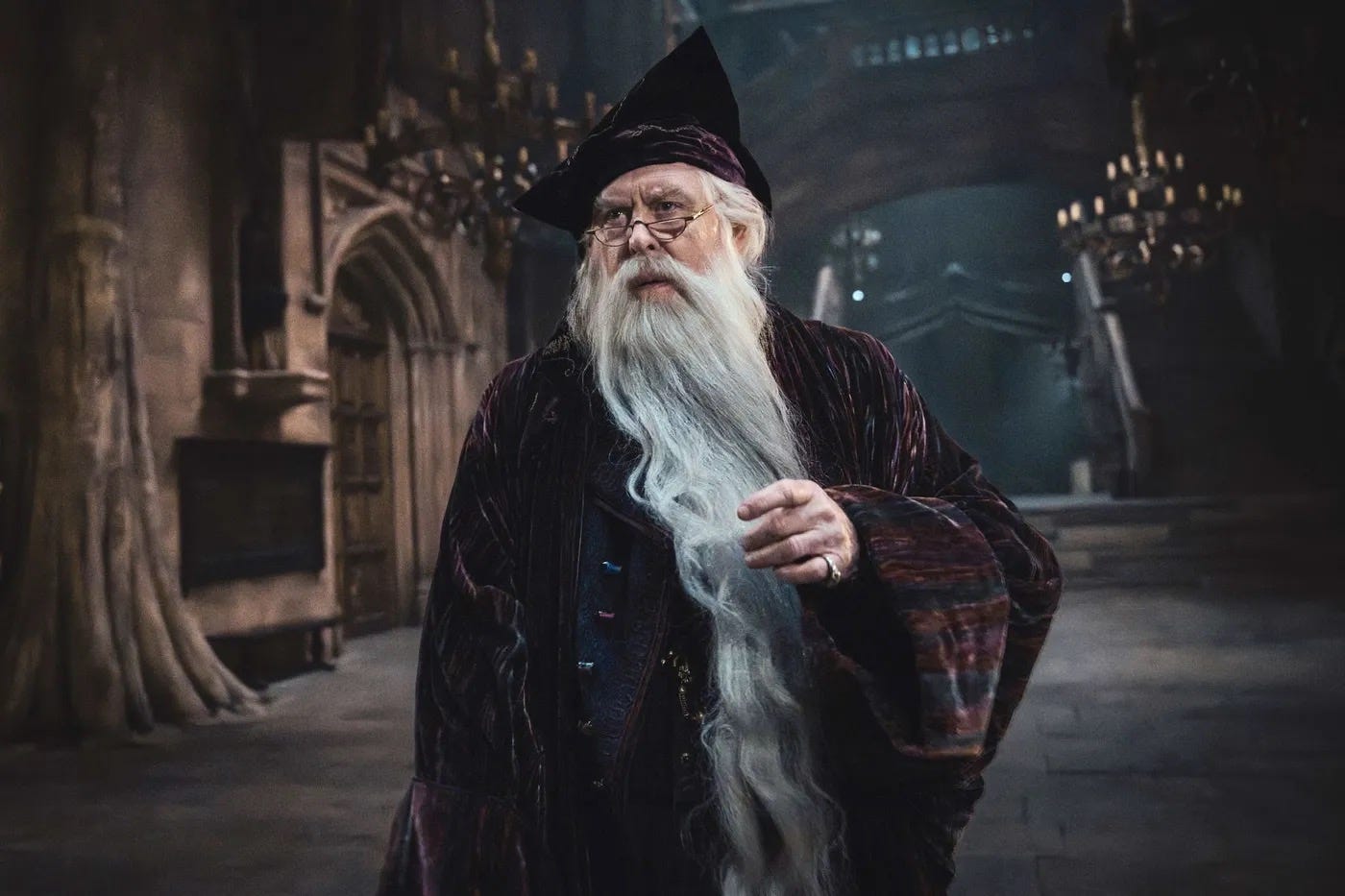
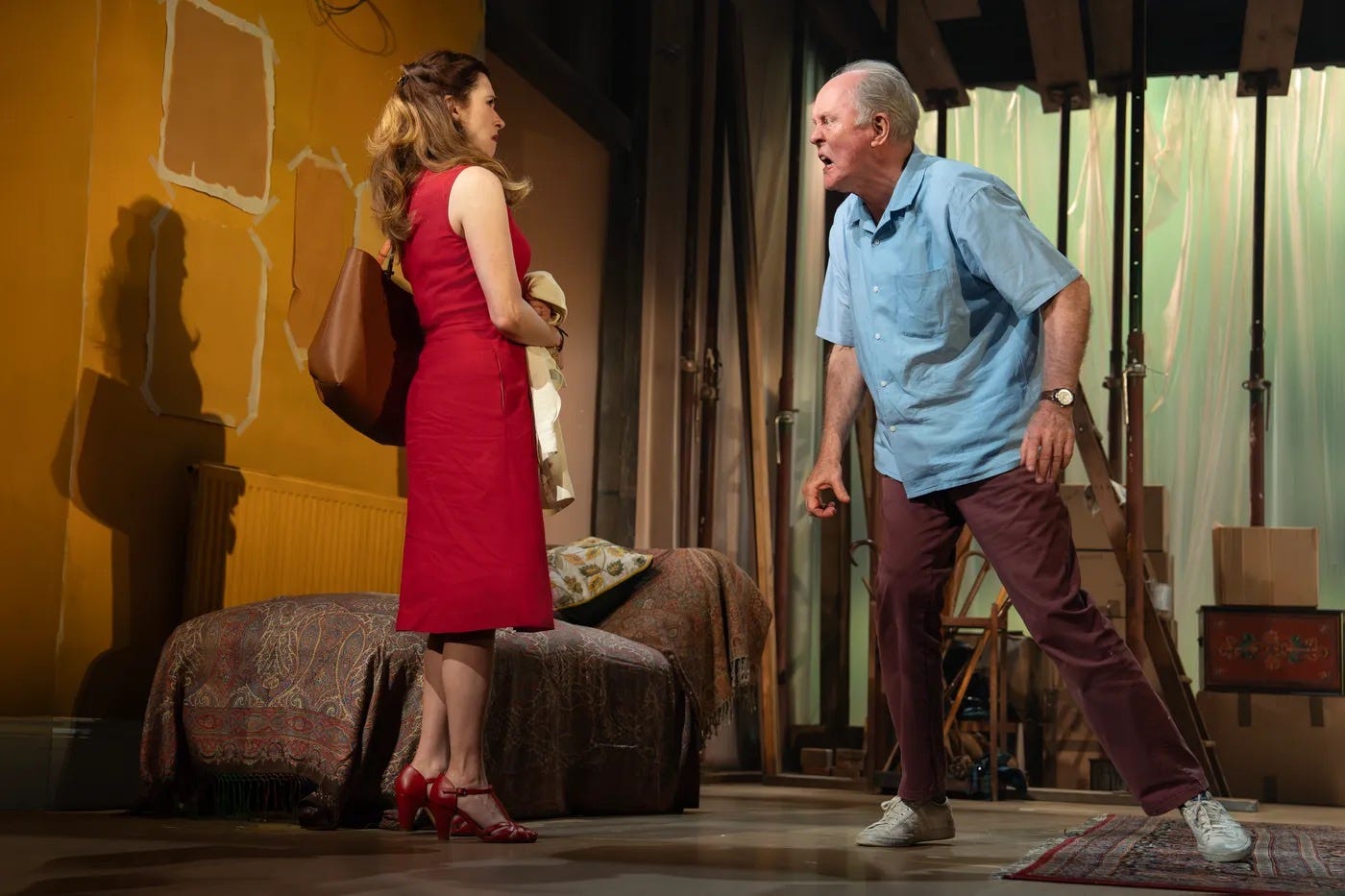
(In Giant and HBO’s Harry Potter and the Philosopher’s Stone. Photos: Joan Marcus (Giant); Lara Cornell/HBO (Harry Potter).
Lithgow’s performance in Giant fills the theater. Levey is moved to mix metaphors when trying to describe what makes Lithgow a great actor. Having worked on this show with him since the workshop, Levey said Lithgow is still improving upon his performance like a master painter: “Every third performance, there will be another brushstroke.” He finds Lithgow’s acting sublime in a chemical sense, as in “sublimation, when you go from a solid to a gas while missing the liquid state. John can do it both ways.” Cash calls him a “miracle actor” whose technical precision at hitting beats is matched by “an incredibly deep emotional well that can fill anything. “Some nights he scares me onstage, which is what he’s supposed to be doing,” she tells me.
Whatever new brushstrokes or gaseous states Lithgow has added in the transfer to Broadway, they’re working. Giant’s New York run has been a success. Tickets at the Music Box are going for hundreds of dollars, even in the mezzanine. Lithgow said friends and theater folk flow through his dressing room every night: “It’s become a regular salon.” Levey tells me one of the biggest differences in the show since it transferred to New York is that it has taken on a “third act,” which is what he calls his five-block walk home from the theater every night. “That can sometimes take an hour and a half, because people stop me, and talk to me about the show, then they invite me to Friday-night dinner,” he said. “There are so many questions that they need answered on the spot, and it’s heaven.” The play’s marketing has latched on to the conversation; the pull quote the show uses in TV ads reads, “There is no more urgent play right now.”
No two people, whether backstage, onstage, or watching the stage, have the same answer to what makes it so urgent. Cash tells me the actors don’t discuss politics with one another. “We don’t talk about this stuff in our cast, and in the rehearsal process, politics were off the table and the ideas were explored within the characters, within the play, as opposed to our personal opinions. That is such an interesting way to work on this and to develop community around something like a play,” she told me. (Lithgow and Levey do email about politics on occasion. “I’ve sent him articles on Omer Bartov, the Brown University scholar on genocide, things like that,” Lithgow told me.) Rosenblatt said the play was not designed for “any particular political persuasion,” that it came from a personal place of loving Dahl’s writing and knowing his feelings about Jews, of wanting “to give some sort of dramatic form to my own confusions.” Levey, who was raised Orthodox in Leeds and has family in Israel, sees the show as an urgent response to antisemitism in the U.K., which makes its Broadway transfer even more poignant for him. “That’s my challenge as a Brit to American Jewry: You’re going to have to fight a bit. You’re going to have to fight when you wake up at four in the morning because everything is changing and nothing can be taken for granted,” he said, drawing parallels to the current situation of Jews in the U.K. to Germany in the 1930s. “It’s so easy for us to slip and slide into a hell.”
To Lithgow, the show’s urgency comes from “the fact that history has precisely repeated itself in the Middle East,” he said. “It’s a play about 1982 and Israel’s incursion into Lebanon, and there have been two major incursions into Lebanon since then. One was two years ago, when we first started the play, and one was right now, when we opened it on Broadway. It’s just astonishingly timely.” Speaking about his performance as Dahl, he continued, “When I turn on Jessie in defense of my review rebuking Israel, and I say they fired missiles into seven of the ten hospitals in Beirut, packed with children, into a mental hospital — that’s about Israel attacking Lebanon in 1982, but they’re attacking them now, and millions are being displaced. And also, a school with 180-plus children was destroyed in the bombing of Iran only in February. That’s just breathtakingly current and urgent.”
I saw Giant at a Saturday matinee during previews with a Broadway audience that was decidedly old and Jewish, even by Saturday-matinee standards. Lithgow & Co. had the audience alternating between attentive, pin-drop silence and laughter for most of the heady, spiraling script until the climax of Act One. I heard more gasps and exclamations in the audience than during any play I’ve been to recently when Dahl called Jessie Stone “Stein” and his publishers “a nasty little cabal of nasty fucking Jews.” A friend told me that when he went to see it, a woman in the audience kept going “Woo!” whenever Jessie brought up Israel’s right to defend itself. Cash confirmed that those lines occasionally get mid-scene applause and whoops and that Dahl’s pro-Palestine lines sometimes receive applause as well. All the actors I spoke to have noticed these gasps and callouts and say New York audiences are having these visceral, audible reactions far more than their counterparts in London did.
Giant is playing to a theater world divided. After October 7 and the Israeli incursion into Gaza that followed, Broadway media personality Seth Rudetsky organized the Jewish Broadway Alliance, a group of Broadway professionals (stars including Tovah Feldshuh and Debra Messing have participated in its events) united to counter the lack of support he saw for Israeli hostages in Gaza. As the Gazan civilian death toll rose into the thousands, Rudetsky went on actor Jonah Platt’s podcast to affirm the notion that anti-Zionism equals anti-Jewish, a conflation that has been used in New York to silence and criminalize antiwar protests on campuses and one that the play’s own Jessie conversely rails against and upholds. Musical-theater composer and lyricist Daniel Maté, son of Holocaust survivor and trauma educator Gabor Maté, is a founding member of an organization called Broadway Voices for Palestine and had a conflicted reaction to Giant. “It’s a rare and fantastic thing to get to see a performance of that caliber by an actor of that caliber,” he tells me, but he found the play felt the need to render a shocking and upsetting verdict about Dahl’s bigotry, “which has the effect of eliding the substance of his anti-Zionism and gives the audience an easy out. They can double down on their assumptions that anti-Zionists are really Jew haters underneath.”
Arielle Angel, an editor-at-large at the leftist magazine Jewish Currents, felt similarly when she saw Giant in April, saying many in the crowd were “essentially Jews who have come to feel victimized.” She felt the script was interesting “despite itself,” but the strength of the performances was overshadowed by the play’s “trying to have it both ways,” with its Jewish characters condemning Dahl for assuming every Jew in the Diaspora supports the actions of Israel and taking personal offense and demanding apologies for his criticism of Israel. “In his own account, which is plenty antisemitic and fucked up and damning, he also asks, ‘Why do they defend it?’ And he’s not wrong about that. The majority of the Jewish world” supports Israel, Angel said, though those numbers are shifting. She pointed out that this production of Giant is co-produced by Shari Redstone, the former Paramount chairperson, who was attempting to tamp down coverage of Israel’s genocide in Gaza on CBS News and 60 Minutes well before the Bari Weiss era. The billionaire media heiress told the New York Times she had left CBS and signed on with an Israeli production company “to support Israel and address issues around antisemitism and racism.” (She and her production partner, Alex Levy, are also behind this season’s Death of a Salesman and Cats: The Jellicle Ball.)
Rosenblatt said that while the play “certainly raises uncomfortable questions for people, I hope, of either position,” he has seen audiences “sit with the spectrum of arguments, rather than feel like they were being lectured or told what to think.” Regarding the reading of Giant as abetting the dangerous conflation of anti-Zionism and antisemitism, he said, “Maybe at the more extreme edges of coverage, there have been one or two pieces that have accused the play of being on one ‘team’ or another, but we’ve had those accusations from both extreme ends, so I think it has allowed people from different sides of the aisle to have a balanced experience.” (Indeed, the lawyer and prominent Israel defender Alan Dershowitz, criticized Giant for portraying Dahl as a “principled supporter of Palestinians.”) Rosenblatt added, “John plays Dahl’s humanitarian compassion as real, and some of his arguments come from the right place. One of the amazing things John does is he plays both as true. They sit parallel to each other. How can you say one thing and then another? How can you be so unaware of your own blind spots? Is it possible to argue meaningfully about these things, to express humanitarian anguish and heartbreak, without saying the things Dahl ends up saying? I’m just trying to have both come from the same person because that’s an interesting paradox.”
In real life, Dahl’s New Statesman interview with a young writer named Michael Coren — who went on to write books with titles like Hatred: Islam’s War on Christianity and op-eds such as “We Should Nuke Iran” — was supposed to be an opportunity for Dahl to explain the trope-filled language of “Jewish financial institutions” and “American Jewish bankers” he had used in his book review. Instead, Dahl doubled down, saying of Jewish Holocaust victims, “I mean if you and I were in a line moving towards what we knew were gas chambers, I’d rather have a go at taking one of the guards with me; but they were always submissive.” He continued, “There is a trait in the Jewish character that does provoke animosity, maybe it’s a kind of lack of generosity towards non-Jews.” Lithgow plays the scene as if he’s enacting a compulsive death drive, digging his own legacy’s grave and pissing on it with Hitler apologias while staying true to Coren’s note that Dahl was “polite and not unfriendly” as he said these things. Lithgow found that “self-destructive anger” the stuff of gripping drama: “I had a friend who said she wanted to climb up onstage and tell him to stop doing this to himself.” As for whether that apology ever came, Dahl’s family issued a formal one for the author’s racism and antisemitism in 2020, 30 years after his death.
Over the course of our lunch, Lithgow would break out into song or act out moments from the play, using tortilla chips to mime Dahl shuffling his papers and slipping in and out of Dahl’s accent. It is quite possibly a switch he can’t turn off. Lithgow has been onstage since he was a toddler; he showed me a photo of himself, age 2, in a production of The Emperor’s New Clothes in an album he brought to our interview, sent to him by Antioch College, where his father worked in the theater department. I asked if the play, especially in its depiction of Dahl’s vulnerability and sweetness toward his children, had made him reflect on fatherhood at all. He briefly reminisced about his own father and his nightly tradition of bedtime stories but noted that he “didn’t duplicate that with my kids. I think I was too peripatetic. I wasn’t there enough for their bedtimes. When they were kids, those were my years of more feverish movie activity.” He’s not troubled by this: “I had a wonderfully close relationship with my kids, but I remember it as very raucous, roughhousing, chasing them around the house, hide-and-seek, playing wild games.” He doesn’t know which wild games he has left in him. “All of these things have been surprises to me.”
Giant is playing a strictly limited 16-week engagement. In August, Lithgow will return to London, where he has recently found a flat not far from Levey, to film the second season of HBO’s long-gestating Harry Potter TV series. It was announced in 2025 that Lithgow would portray Hogwarts headmaster Albus Dumbledore in a big-budget episodic adaptation of J. K. Rowling’s boy-wizard books. What motivates an actor in his ninth decade on earth to sign on to a multiyear project that, if filming stays on schedule, will wrap when he’s 87? “Those books are an amazing phenomenon, and I really do believe in this project fervently because of the people who are creating it, showrunner Francesca Gardiner and director Mark Mylod,” he said.
Over the past decade, Rowling has become a figure of controversy for obsessively spouting bigoted views against trans people. In recent years, she has shifted from simply bullying trans people to materially supporting legislation in the U.K. that changes the legal definition of woman to exclude trans women, eroding their rights. Lithgow said he had no idea about any of this when he accepted the role but has wearily resigned himself to a lifetime of distancing himself from her opinions in interviews. “I’ve never met her,” he said. “She’s not directly involved with the production. In fact, long after it airs, I could get together with you and tell you some of the things I’ve contributed, bright ideas on the set that were radical ideas, and Rowling never even knew about it. She was never even told about the bold liberties we’ve taken with the material because she trusts Francesca Gardiner and Mark Mylod, and they trust me. It’s going to be marvelous. And so far, I’m very glad I signed on, and I’m saddened that it’s upset a lot of people, including some very good friends of mine. I take the issue very seriously. I’m on the side of transgender people. I know their complaints; I know some of the issues. How can you be prejudiced against a person who has dealt with that?” (Through a representative, Rowling declined to comment. An HBO spokesperson said the author “is working very closely with Francesca and Mark in the creation and production of the Harry Potter series, including reading scripts and casting … and the show is better for it.”)
He pointed to his “whole history with gender-fluid characters,” including his performance as Roberta Muldoon, a trans woman, in 1982’s The World According to Garp, which got him the first of his two Oscar nominations. I asked if those “bold liberties” he’s taking with the material refer to whether he will play Dumbledore as gay, a revision Rowling made to the canon after the books had been released. “Exactly. This is something I have dealt with in many roles I’ve played. I find it fascinating because, to me, great art comes out of people’s pain. And these are people who struggled with tough issues,” he said. While not confirming this will be an overt element of his performance, he said, “I consider it a very good thing that I’m playing Dumbledore. It gives me a chance to talk about these issues in a compassionate way.”
“Whatever you think about J. K. Rowling and her eccentric views that I don’t agree with,” he added, “she has created something amazing for children.” In many ways, Rowling is the most apt contemporary parallel to the version of Dahl on display in Giant — a massively influential British children’s novelist who has disappointed legions of her adult fans who grew up attached to the series. Many now boycott any new works to come from the Potterverse so as not to contribute further to Rowling’s wealth and influence. Maybe, many decades from now if Broadway still exists, a virtuosic actor raised on Lithgow’s Dumbledore and the HBO series will be nominated for a Tony for her portrayal of Rowling’s transphobia in a play much like Giant.