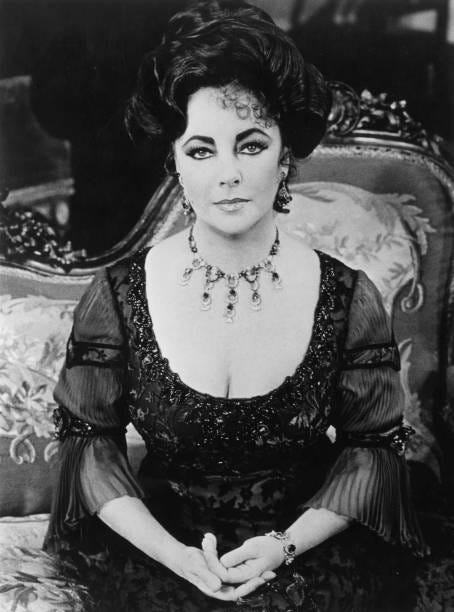
Elizabeth Taylor stands center stage, one hand on her hip. Her eyes are heavily made up, neo-Cleopatra style, her lips are the same blood-red as the toenails that peek saucily from her gold spike-heeled sandals. She is thin now -thinner than she’s been since her 20’s -having lost 40 pounds at a Florida spa before she began rehearsing Lillian Hellman’s ‘’The Little Foxes’‘ one month ago.
She has just finished a scene that calls for much angry screaming. ‘’How did I do?’‘ she asks Austin Pendleton, the director, in a voice of such absolute innocence that one wonders if her bawdy appearance is a mirage.
‘’Well, Elizabeth,’‘ Mr. Pendleton answers in affectionate, relaxed tones, ‘’by now the audience will have completely given up hope that this is going to be ‘National Velvet,’ so you will have lost them!’‘
‘’Ha!’‘ Miss Taylor screeches and throws back her head in merriment. She loves being surprised with a laugh. It’s not that she doesn’t work. She works impressively hard, dutifully responding to Mr. Pendleton like a little girl who knows she can please the teacher. ‘’She gives you what you ask for,’‘ says her appreciative director. But, like a happy student, she looks forward to recess most of all.
Of course, this is not a school play. This is a $500,000 revival of Miss Hellman’s 1939 drama, and with one of the biggest advance sales in history (due entirely to the astounding drawing power of its star) it will open Thursday at Broadway’s Martin Beck Theater after having played four weeks in Fort Lauderdale and six weeks at the Kennedy Center in Washington. Elizabeth Taylor has never been in a play before. The stakes are high.
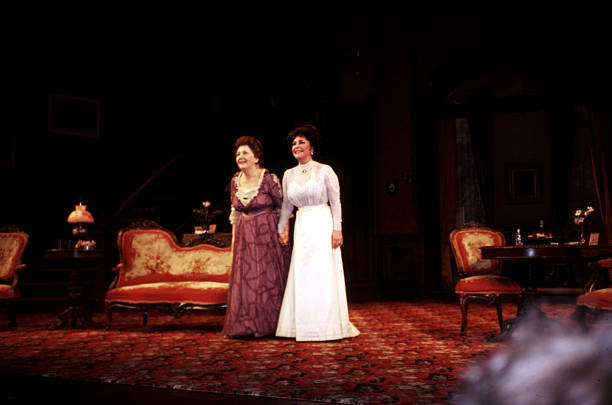
The play is grim. In a small Southern town at the turn of the century, Regina Giddens murders her ailing husband and outwits her two avaricious brothers for control of a fortune. Tallulah Bankhead, in the original production, and Bette Davis, in the movie, played Regina with fierce viciousness in the grand style. Miss Taylor, however, is a picture of misused Southern femininity, who seizes her long-deserved power when finally given the opportunity.
‘’When you enter the dining room, Elizabeth,’‘ Mr. Pendleton says kindly, ‘’I want you to come from stage right.’‘ ‘’Stage right?’‘ she looks around in some confusion. ‘’Which is stage right?’‘ The rest of the cast stares at her in disbelief. After four weeks of rehearsal, is it possible she never learned this fundamental concept? But even more perplexing - it doesn’t seem to bother her.
‘’You can’t be a star if you don’t know stage right,’‘ booms Anthony Zerbe, who plays her brother, Ben. Elizabeth shrugs and giggles.
Gray-haired, sad-eyed Maureen Stapleton, who recently was elected to the Theater Hall of Fame after more than 30 years on the stage, sits in a chair on the set and leans forward tensely. She plays Birdie, Regina’s oppressed sister-in-law. Wearing an old brown-plaid bathrobe and loose, worn slippers, she dangles a pair of eyeglasses from her hands, which are clasped tightly at her knees. She is terrified. She’s not sure she has a grasp of her character. She’s not even sure she’ll remember her lines. When she speaks, her deep, melodious voice is merely a whisper, because the fear takes her breath away.
‘’Don’t you have any fun rehearsing a play?’‘ someone asks her. ‘’I’ll have fun after we’ve opened in New York, after they judge us,’‘ she says. While Miss Stapleton rehearses a scene with Joe Ponazecki (who plays Oscar, Birdie’s husband and Regina’s brother) Miss Taylor clowns around in the wings. She does mock-calesthenics, waving her arms and grinning. Mr. Zerbe teases her and she sticks out her chin in a pout.
Since rehearsals began, the cast has been amazed by this jolly, raucous woman, who comes and goes in a chauffeured Rolls-Royce Silver Cloud. ‘’A nice lady,’‘ says Dennis Christopher, the young star of the movie ‘’Breaking Away,’‘ who plays Regina’s scheming nephew.
They all expected she’d be temperamental. She isn’t. They expected she’d lord it over them. She doesn’t. But most of all, they expected she’d be intimidated by her first theatrical venture. So far, she’s not. Everyone is waiting for the panic to hit her. Opening night still lies ahead.
A few days later the big night arrives. Backstage, the company is exhibiting classic behavior. Miss Stapleton is throwing up. Mr. Zerbe is running in place, his eyes glinting in frenzied anguish.
Austin Pendleton, his gray hair twisted into wild tufts, his glasses steamy, is pacing the halls, tortured by visions of being replaced. ‘’God, they’ll call in Vivian Matalon! Or Mike Nichols!’‘ The ashen-faced producer, Zev Bufman, stands close to his star’s dressing room, as if his proximity (constant since the beginning) will protect them both. A few months earlier, he had approached Miss Taylor with the offer to produce any play she chose. He preferred Noel Coward’s ‘’Hay Fever,’‘ but she wanted ‘’The Little Foxes.’‘ And now, opening night of this first out-of-town tryout, they will put themselves on the line before the first batch of critics.
Sitting in the midst of hundreds of roses, in her white plush dressing room, Elizabeth Taylor works on her eyes with a black pencil and hums a little tune. She is calm, expectant, elated. She can’t wait to get on.
There is a festive mood in the audience. Of the top box-office stars, only three women have remained in the top 10 for 10 years: Betty Grable, Doris Day and Miss Taylor. But Miss Taylor remains the number-one female box-office draw of all time. Recently, her movie public has dropped off, but the world has always been curious about her. All those marriages, all those illnesses; what is a woman like who has lived through such turmoil?
From the moment she steps on stage, to the gasps of an audience awed by her beauty, her composure is absolute and her privacy inviolate. She is Regina Giddens. All thoughts turn to the play.
At the opening night party, in a swank Miami yacht club, Elizabeth Taylor arrives to flashing camera bulbs and a crush of oglers. She waves a bejeweled hand. Her sixth husband, Senator John Warner, is at her side, smiling proudly. ‘’Hi,’‘ he says later, many times, ‘’I’m the country boy who married the girl who’s in this show.’‘ Mr. Bufman, beaming, leads Miss Taylor to a table, where she sits all night long, never mingling with the crowd.
The cast appears disconnected. Their Elizabeth has been replaced by this potentate, and they feel humiliated. No one approaches her table.
Joe Ponazecki, a long-suffering victim of stage-fright, tries to explain Miss Taylor’s serenity under fire. ‘’I think,’‘ he says, ‘’she just doesn’t know enough about the theater to know she’s supposed to be scared.’‘ ‘’I think it’s because she has been a survivor of so many things,’‘ Miss Stapleton says. ‘’And she’s done her surviving under such public scrutiny.”
Mr. Pendleton offers his theory: ‘’What are we afraid of when we have stage fright? We fear condemnation. She’s already had that in spades. What more can people say?’‘
It’s true. Miss Taylor at her table is protected by her pacing, exotic, Egyptian press agent, who turns away supplicants with an imperious wave of her hand. Her staff’s vigilant measures to guard her haven’t prevented the press from attacking. She’s been criticized for everything - spending money, breaking up marriages, wearing gaudy clothes, her acting ability.
On Sunday, the day off, Senator and Mrs. John Warner invite the company for a day on a borrowed 82-foot yacht. To everyone’s amazement, Miss Taylor wears the Krupp diamond. This is the first time anyone has seen the flawless 33.19 carat, square-cut gem. It glistens in the sun and draws all eyes.
Miss Taylor is in high spirits. In gleeful abandonment, she lets everyone try on her ring. ‘’Don’t cut yourself,’‘ she says as she throws it to Richard Nelson, Mr. Christopher’s assistant. ‘’Look into the stone and see the corridors that go down it.’‘ (Later, Mr. Nelson recalled his panic at having been tossed ‘’three million dollars worth of ice! I thought, ‘What if I just threw it overboard?’ Or kept it and said, ‘Oh, I gave it to Maureen, doesn’t she have it?’”)
Elizabeth Rosemond Taylor was born in London in 1932 to American parents. When war was imminent, the family moved to Beverly Hills. Her mother, a former actress, encouraged her desire to be in movies, and at the age of 12 her third picture, ‘’National Velvet,’‘ made her a star.
Miss Taylor’s life since then is well known. Seven marriages: Nicky Hilton, Michael Wilding, Michael Todd, Eddie Fisher, Richard Burton (twice), John Warner. Fifty-four movies: among them ‘’The Father of the Bride,’‘ ‘’A Place in the Sun,’‘ ‘’Giant,’‘ ‘’Cat on a Hot Tin Roof,’‘ ‘’Suddenly Last Summer,’‘ ‘’Butterfield 8’‘ (for which she won an Academy Award), ‘’Cleopatra’‘ and ‘’Who’s Afraid of Virginia Woolf?’‘ (another Academy Award). Numerous critical illnesses, a personal tragedy (the death of Mike Todd in a plane crash) and several scandals - most notably her marriage to Mr. Fisher (she was accused of stealing him from his wife, Debbie Reynolds) and the Burton affair during the filming of ‘’Cleopatra.’‘ The fact that both Mr. Burton and Miss Taylor were married at the time enraged the public so much that the Vatican published a letter to her, accusing her of being an unfit mother. But, as her fans well know, she is a doting mother of four children: two sons by Michael Wilding, one daughter by Mike Todd and an adopted daughter whose last name is Burton.
Elizabeth Taylor sits in her Miami hotel room, wearing a fuchsia caftan, slit to mid-thigh. She is barefoot and wears no makeup. Cameramen have often commented on the perfect symmetry of her face, which gives an unsettling faultlessness to her beauty. Close inspection reveals no surgical scars, so one wonders about the lack of lines. She looks untouched by life.
‘’I’ve always wanted to do a play, but the timing never seemed right,’‘ she tells a visitor. ‘’This seemed the moment because my husband is terribly busy with the new Administration. And I’ll be doing six weeks in Washington, which is nice, so we will be together. And he was so supportive. He was 100 percent behind this. He’s very proud of me that I took the plunge.”
‘Were you frightened your first time on stage?’‘ her visitor asks. ‘’No.’‘ ‘’Why not?’‘ ‘’I’ve been acting since I was 9, and I’ve always contended that acting is acting. Of course, you have to modify to your audience. In film, everything is much more played down, much more the expression of the eyes. The body movement is minimized and you don’t project your voice.’‘
‘’What is it like to work for Mr. Pendleton?’‘ She smiles. ‘’Sometimes Austin will get carried away with images that have nothing to do with the action, the motivation, and my eyes start to cross. The first time he did that, I started to feel I was going to giggle, and I said, ‘Which line would you like me to put all of that into?’ ‘’ She squeals with laughter.
‘’But I take from him what I can use,’‘ she says seriously. ‘’I find I can condense his analysis into something I can identify with - and that usually is a sentence.’‘
She sits so still, so composed, so satisfied. It’s disorienting. Does she ever get depressed? ‘’Not easily. I do have a very mercurial temper. It explodes like an atom bomb. Then it settles.’‘ ‘’You don’t ever get depressed for a couple of weeks?’‘ ‘’Oh, God no. A couple of weeks?’‘ She roars with laughter. ‘’Have you ever been to an analyst?’‘ ‘’Never. I think you’re here on earth to try and work out your own problems.’‘ ‘’Why do you put on weight?’‘ ‘’I think inactivity has more to do with it than anything else. When I was campaigning for John, I was very active, and then, once he became Senator, I was very inactive. But I’m not hung up on vanity. I don’t care when I’m fat at all. It doesn’t bother me one bit. It bothers everybody else.”
‘You’ve had so many different chapters in your life, been married to such different men. Have you changed each time?’‘ ‘’No. The circumstances around me have changed. I’ve been the same.’‘ Silence. ‘’What do jewels mean to you?’‘ ‘’I think what I love is the perfection of the diamond itself. And that’s nature. It’s something so perfect that you have to enjoy it or you’re very jaded.’‘
‘’Which movie did you enjoy making most?’‘ ‘’ ‘National Velvet’?’‘ She answers like a child who’s suddenly unsure. Then she looks out the window, to palm trees swaying in the wind, and smiles to herself.
In New York, there is one man who might be able to explain Elizabeth Taylor, a man who has known her since she was a child. Joseph Mankiewicz, the Hollywood director-writer, who created ‘’All About Eve’‘ and who directed Miss Taylor in what many consider her best screen performance, ‘’Suddenly Last Summer.’‘ He also directed the ill-fated ‘’Cleopatra.’‘
He sits in the study of his Bedford Hills estate and reminisces: ‘’The first time I saw Elizabeth grown-up was when I was in France making ‘The Barefoot Contessa.’ I was coming out of the Carlton Hotel in Cannes just as she was walking into it. She was alone, about 18 years old. She was the most incredible vision of loveliness I have ever seen in my life. And she was sheer innocence.
‘How could she know nothing of life?’‘ he was asked. ‘’Easily. You see, Elizabeth was given over to the convent of M-G-M at a very early age, just as Judy Garland was given over. What these little girls learned, they learned from the screenplays that they played. They had no other contact with life. And the rules that they conformed to were the rules laid down by the Hays Office, the censorship office. You do not indulge in back-street romance. That woman always comes to a bad end. If you love your lover, you take him by the hand and confront the world openly with him. But she found out when she did that in real life, she got belted right in the puss. But when she did it on the screen, she was a great star. This makes for tremendous confusion.’‘
He sits back and lights a cigar. ‘’Look, when you see Elizabeth now, you are seeing Mrs. John Warner. She is Mrs. John Warner who is appearing on the stage under her maiden name, doing her husband no end of good and making him proud. Thus, she is successful in her primary role. Just as she was Mrs. Michael Wilding and had people in for English tea. Just as she was Mrs. Eddie Fisher and told Yiddish jokes and let him sing ‘That Wonderful Face’ as she sat at a table night after night so the audience could see what he was singing about. Just as she was Mrs. Richard Burton and drank and fought like a Welsh broad. The principal role in Elizabeth’s life has always been as the wife of the man she’s married to.’‘
‘’Was she ever without a role?’‘ he is asked. ‘’When Mike Todd died, she had no time to prepare at all. She was right in the middle of playing this thing to the hilt, and bam, to be torn - no preparation. I think her only relief was to be inaccessible. I think that’s why she made the terrible mistake of marrying Eddie Fisher. It was like grabbing a coat.’‘
‘’She claims she’s been the same through all her marriages,’‘ his visitor says. ‘’She has been the same through all her marriages. She’s been whatever she was supposed to be. Whatever the script called for, she played it. I could visualize Elizabeth, age 55, wearing a burlap muumuu in a garret in Paris -it would be a cozy garret, mind you -and she would be entertaining the 1988 equivalent of the Cubists or whatever-the-hellists and trying to learn their language. And saying to you, ‘I’m exactly the same as I was when I was married to Senator Warner, but the screenplay has changed, the costumes have changed, the supporting players have changed. I am the same.’
‘Unless Elizabeth Warner, Elizabeth Burton, Elizabeth Fisher, Elizabeth Todd, Elizabeth Wilding and Elizabeth Hilton are six separate, distinct characterizations, her life doesn’t make sense. The thread that goes through the whole is that of a woman who is an honest performer. Therein derives her identity. If she’s a success at that, she’s totally invulnerable.’‘
March, Washington, D.C.
Upstairs in the Kennedy Center after a preview, Mrs. John Warner sits with her husband at a table and eats a salad. The occasion is a reception for junior Congressmen. As the royal couple eats, a crowd forms around them. These are attractive, intelligent-looking men and women, the sort one sees at Ivy League reunions, and they are simply watching. A woman works her way out of the circle and says to her husband, ‘’Your turn to look at Liz.’‘
Lillian Hellman is in Washington. Everyone (except, of course, Miss Taylor) is frightened of her. From the start, she has been difficult. First there was a contract hassle with the producer, which was only resolved when he leaked news of the production to the press. She was also critical of the sets and costumes.
But most of all, everyone is afraid of what she will say to the company. She has, reputedly, never liked a production of this play. She loathed Anne Bancroft’s performance in Mike Nichols’s revival at Lincoln Center in 1968, and she grew to hate Tallulah Bankhead in 1939. Plus, she is notoriously hard on actors.
Tonight, after the performance, the company is asked to assemble in the green room. Lillian Hellman makes a slow, stately entrance, led in by Mr. Pendleton and Mr. Bufman. Seventy-three years old and nearly blind, she lowers her eyes; her mouth is open in strain. Mr. Pendleton seats her carefully on a sofa in the center of the room.
‘’I want to thank you all very much,’‘ she begins in a deep, quavering voice. ‘’I sat with Clayton Fritchey (the journalist) and he said he’d seen five productions of this play, and this one is the best.’‘
Faces all around smile. Sighs are heard. ‘’It all worked out so well ...’‘ Her voice trails off. ‘’And the costumes look lovely. Regina’s first-act dress is a dream. I want it myself.’‘
Miss Taylor steps forward. ‘’I’m sorry to have paraphrased you so much, Lillian,’‘ she says sweetly, earnestly. ‘’I’m afraid I mixed up a few lines.”
‘Where was that?’‘ ‘’Don’t tell, Elizabeth, don’t tell!’‘ Miss Stapleton calls out. ‘’I noticed one place ...,’‘ begins Miss Hellman. ‘’That was it!’‘ Miss Taylor shouts and throws Miss Stapleton a grateful look. Everyone laughs. Miss Hellman is smoking fast and smiling at the same time. To Miss Stapleton, whom she’s known for 25 years, she says, ‘’You look awfully pretty up there.’‘
‘’Now I know your eyes are bad,’‘ laughs Miss Stapleton. ‘’And the wig - you ought to keep the wig forever. And it wouldn’t hurt to dress in period.’‘ Her deeply lined face draws up into something resembling a playful look.
‘’You sure know how to make a girl feel good,’‘ Miss Stapleton says sarcastically. ‘’You’re going to make a lot of money, Maureen, and I want you to spend it. I want you to have gorgeous clothes.’‘ ‘’I spend my money ...,’‘ Miss Stapleton pauses dramatically, ‘’ ...on fig newtons, jelly beans.’‘ ‘’Well, I don’t think we should buy you jewelry,’‘ says Miss Hellman, who knows that Miss Stapleton pines for it. ‘’I want you to have lavish clothes.’‘
‘’Forget the clothes. I’m in the jewelry class now.’‘ ‘’I’m thinking clothes.’‘ ‘’Think jewelry.’‘ Miss Hellman looks off into space, then suggests a line change to bring out a laugh. ‘’I love laughs,’‘ she says in a firm, husky voice. ‘’I would stand on my head for a laugh.’‘ When she leaves, the members of the company look at one another in astonishment. It was not the scene they had expected.
The audience on opening night in Washington looks like a magazine advertisement for Chivas Regal. This is a world of sequins and taffeta, from which all ragged individuals seem to have been banished.
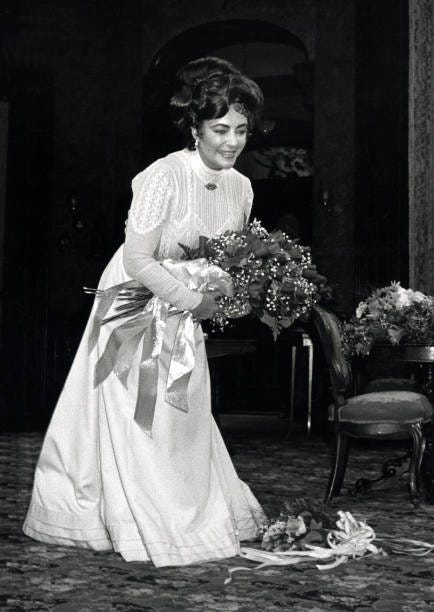
Senator John Warner sits with President and Mrs. Reagan in their box. The occasion inspires Miss Taylor’s best performance to date. At the curtain call, she sinks into a little-girl ballet curtsy and acknowledges the thunderous applause with a fetching smile. It is her finest moment.
Photographs: 1. MPI. 2. Ron Galella. 3. Walter McBride.