By Daniel Stern for The New York Times, March 28, 1976
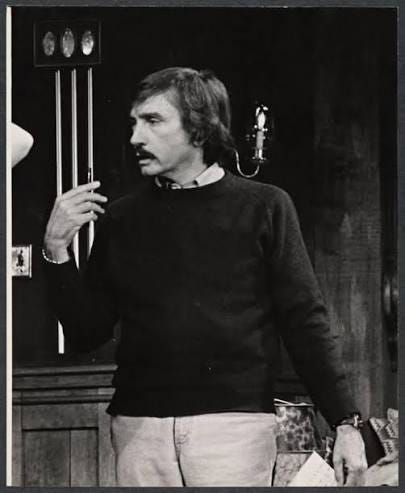
“I've been sneaking up on this second career, this directorial thing, over the years,” said Edward Albee. “I started directing with ‘The Zoo Story,’ American Dream’ and ‘The Sand Box,’ in revivals, as early as 1963. I've even directed a couple of other people's plays—I did Howard Moss's ‘The Palace at 4 A.M.’ in East Hampton—and of course I did ‘Seascape’ on Broadway last season.”
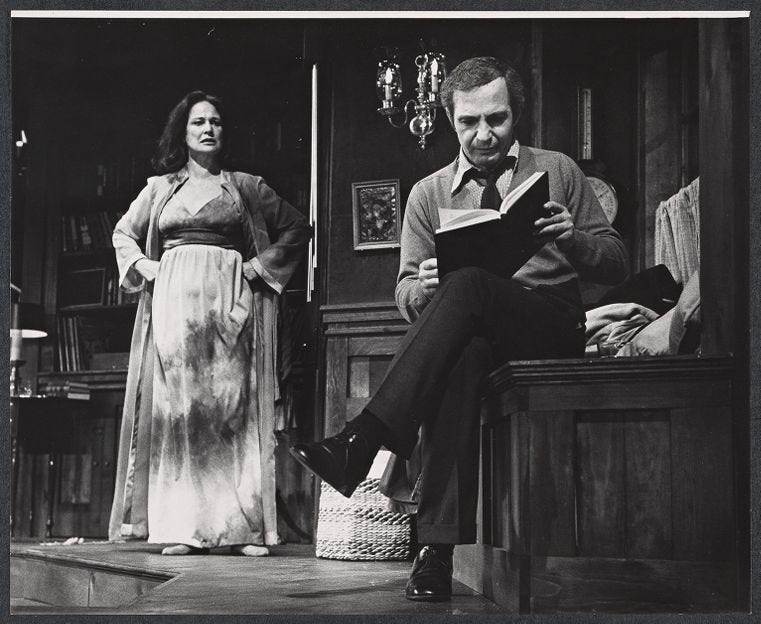
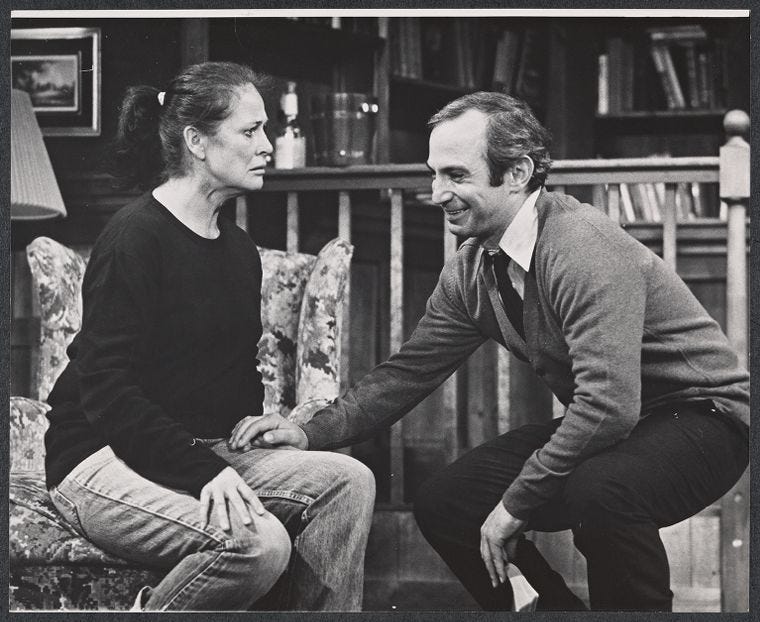
Albee, at 48, is directing the Broadway revival of his most famous play, “Who’s Afraid of Virginia Woolf?” The production, starring Colleen Dewhurst and Ben Gazzara, opens Thursday at the Music Box. If the challenge of directing his own greatest success has made him at all tense, it was not evident during a recent discussion of the play and its extraordinary history.
It was 14 years ago that “Virginia Woolf” opened on Broadway, starring Uta Hagen and Arthur Hill and directed by Alan Schneider. The result was instant fame for the 34‐year‐old Albee, who had “started writing plays as a kind of present to myself on my 30th birthday.” His first plays, among them “The Zoo Story” and “The American Dream,” were staged Off Broadway and were all dense, difficult works of great intensity. But there was nothing to prepare critics or public for the impact of “Virginia Woolf.”
The play ran for 664 performances and was the big dramatic hit of the 1962/63 season. It won five Tony awards, including Best Play of the Year, as well as the New York Critic’s Circle award for Best Play.
But when it came time to award the Pulitzer Prize in drama, rather than give the prize to the Albee play, the Pulitzer judges chose to make no award at all. Two members of the advisory committee, critics John Gassner and John Mason Brown, resigned in protest. The problem seemed to be simply that the language was too rough for the judges. Two other Albee plays have since won Pulitzers: “A Delicate Balance” and “Seascape.”
Albee speaks with amused nostalgia about the mixed reception accorded the play. “It was a commercial success, yes. But the critics were half wildly enthusiastic, the other half full of loathing. As they have been, by the way, with all my plays.” He laughs. “It’s a very interesting career I’ve had in the theater.”
Why has his career moved him into directing? “Well, I think not every playwright should direct his own work. But, if you can stay sober, if you’re reasonably articulate, know how to work with actors, and if you can remember what you intended when you wrote the play, and if you’re willing to put up with the tedium—as well as the excitement—of directing, you can probably, if you’re somewhat objective, end up with a fair representation of what you intended.”
He smiles at this long, qualified rumination and adds, “You won’t necessarily end up with the most effective production. But you’ll have what you originally intended: And at this point in my life I’m much more interested in making my intentions clear.”
What had been unclear about the first “Virginia Woolf”?
“Well, when the play first opened, I was confused by certain reactions among critics and audiences. People seemed to think that George and Martha actually believed there was a real child. Naturally, they found it hard to accept the notion that two such rational and articulate people believed they had a kid when they didn’t. What I’m trying to get clear now is the death of the child is the death of a metaphor—a metaphor with which these two have been sustaining, and torturing, themselves.”
How did he deal with that, in directing Miss Dewhurst and Mr. Gazzara?
“At first they were playing the death of a real child. And what we were getting was a kind of dirge‐like quality … mourning. It was heavy and yet not really intense. After I explained the child as a kind of metaphoric game‐playing, the dirge‐like quality was gone. And they were playing more intensely.”
Was Albee at all inhibited by the knowledge that he was following such distinguished directors of “Virginia Woolf” as Alan Schneider, Franco Zeffirelli and Mike Nichols?
“No,” he replied. “You see, Schneider and I worked very closely. Zeffirelli essentially copied the New York production. And Nichols only did the film. It was quite good as filmed versions of plays go, but directing films is another matter entirely. I’ve been lucky with ‘Virginia Woolf.’ No director has tried to superimpose his personality to the extent of doing damage to the clear line of the play. Maybe that’s because the play has a very clear line. Nobody has tried to put in too many improvements. So, though there have been splendid directors at work over the years, I haven’t had a variety of interpretations to work through.”
How would he characterize himself as a director?
“Look,” Albee said, “three-quarters of the trick of directing is to start with a good play and good actors. If you’ve got a good play, then the job is to plot out your work very carefully, but still leave room for improvising, for a certain amount of on‐the‐spot intuitive directing. No matter how organized you are it’s good to he flexible enough to be able to surprise yourself with new solutions.”
What happens when actors resist directorial suggestions?
“Really good actors don’t resist reasonable direction. If a good actor does resist—then, if you’re smart, you think twice about your suggestion. Finally, if you want to know about a director, you’d better ask the actors.”
Over a dietetic dinner and a glass of club soda, Colleen Dewhurst admits to having launched the current production. “The whole thing started when the people at the Kennedy Center asked me to appear in the Bicentennial theater series they were doing. When I found out they were not doing any play by Albee, I couldn't believe it. Well, I'd done ‘Virginia Woolf’ in stock—just two weeks—and I thought, ‘This is the time.’ I called Edward and he was interested and here we are.”
How is it to work with a director who is also the playwright?
“I was nervous at first, because the language is so incredibly lovely, it’s like learning to work with poetry or music; it needs real ensemble playing, One of the reasons Edward agreed to direct this production is that there are things he wanted brought out that haven’t been brought out before. He helped me track down the character of Martha, helped me make her more human—not just neurotic, and not stupid. When she’s struck down by George, at the end, there’s a temptation to indulge in self‐pity. But Edward helped me to avoid the typical woman’s response to a child’s death. Played his way, it’s unsentimental—and just as moving.”
Earlier, Albee had been telling me how he felt about the different interpretations of “Virginia Woolf”: “The play is an examination of whether or not we, as a society, have failed the principles of the American Revolution. There’s no argument that George and Martha were named after George and Martha Washington. And their non‐existent child is our failure to follow those principles, not staying an adventurous and revolutionary society.”
How about the oft‐voiced notion that George and Martha are really a homosexual couple squabbling about a child they naturally couldn’t have?
“That’s a bunch of nonsense. I remember one critic saying that the only way he could accept the play was if he didn’t have to see it as a heterosexual relationship. I reread the play to see if it can function on the homosexual level and it can’t! In fact, I asked Uta Hagen, Elizabeth Taylor and others who had played Martha if they thought they were playing a man. Well, it had never occurred to them. You know I get lots of requests from amateur groups to do this play with four men. I’ve left very simple instructions: Do the play the way it was written, with two men and two women, I used to be quite annoyed. But now it’s kind of funny.”
At a rehearsal later that day, I watch as Albee suggests to Miss Dewhurst that she use the mantelpiece of William Ritman’s one‐room set to better advantage—perhaps get a suggestion of power by putting her elbows up behind her (the mantel turns out to be too high). He discusses with Ben Gazzara the precise reason for his anger at Martha at the beginning of Act One. The anger, Albee suggests, derives from Martha’s behavior at the party they have just left.
This is Gazzara’s first appearance in an Albee play. I ask him about Albee, the director.
“For a playwright/director he’s very practical. He spends a lot of time blocking the play. He said he wants a sense of how people would move if they’d been living in that house for years. And I don’t know if it was Albee the playwright or Albee the director who put more love in the play, but he sort of gave us the permission to make it a love story, not a hate story. For me, personally, Edward helped me see the way George enjoys language—the pleasure he takes in putting words together. After all, he is an academic. And this triggers more humor as he spars with his wife. There’s a mutual pleasure in their struggle, and language is the chosen weapon. I think all the motivations are strong and clear this time out.”
The run-through goes smoothly. Albee takes notes and restlessly crosses from aisle to aisle in the empty theater, looking at the stage from different angles. The dialogue, prompted lines notwithstanding, crackles.
At one point in our discussion, Albee had remarked about the film version of his play, which starred Richard Burton and Elizabeth Taylor. “Curiously enough, the film became a story from the woman’s point of view. Burton trying so hard to support Elizabeth, I suppose. But it became a one‐sided affair. That’s not happening here, with Colleen Dewhurst and Ben Gazzara. They’re both strong performers — such tough actors—that It’s an equal battle. In this play, balance is everything.”
Afterward, as we stand outside the theater for a moment, I remember how much the original experience of this play had reminded me of Beckett. Albee, leather coat slung over his shoulder, is ready to sprint away, when I ask him about the influence of Beckett.
“I take sustenance from wherever I can get it. Chekhov, Beckett, Noel Coward. Back in 1962, when I was just getting started, I made a list of 25 living writers that a whole slew of critics in Europe and the United States had compared me to. It included six whose work I didn’t know. It’s a game after a while—who resembles whom. I’m involved in a life and death struggle with myself.”