Broadway Bomb
From the beginning there was something odd about "Moose Murders." The best thing about this play was that it closed quickly.

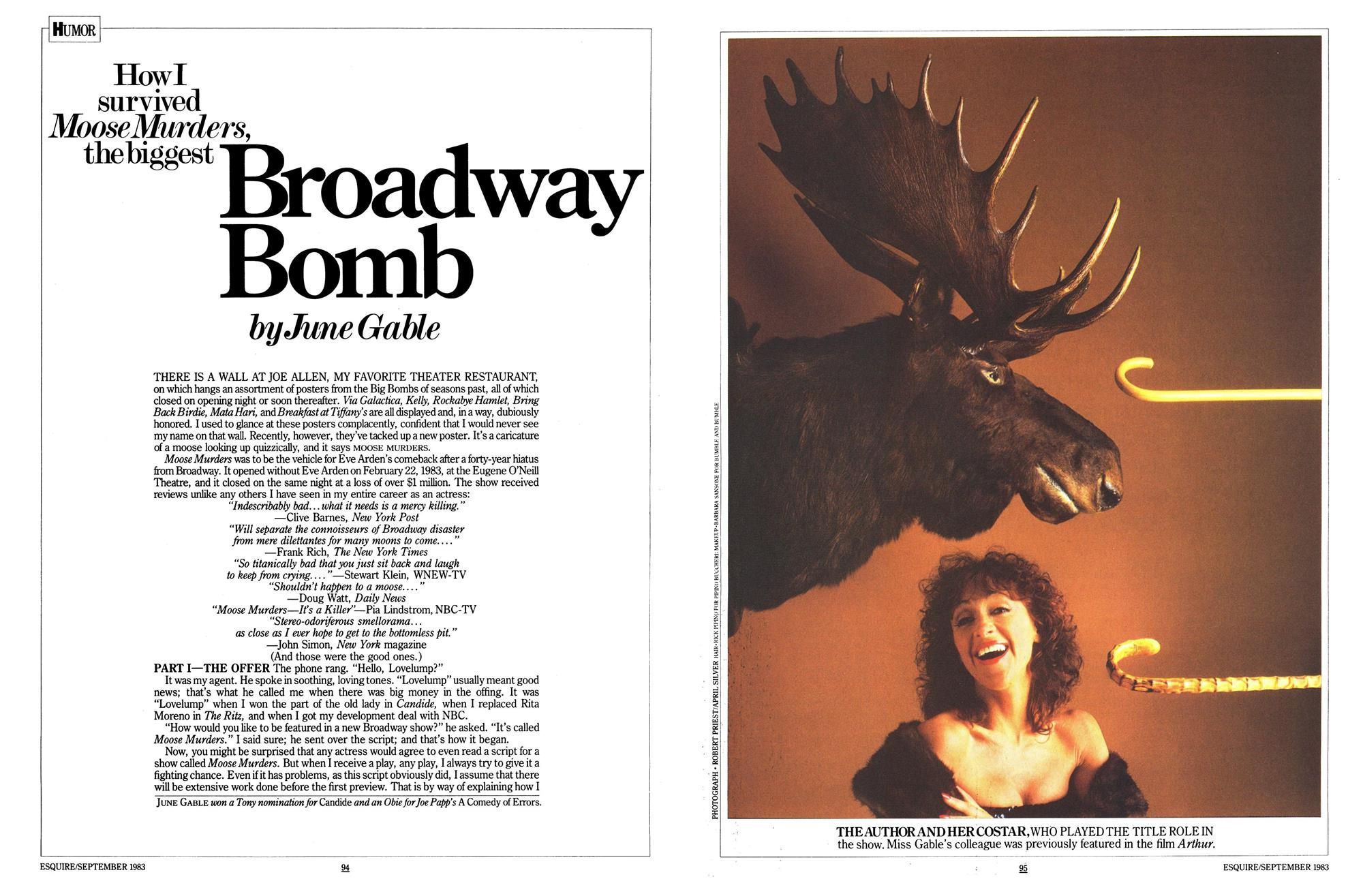
By June Gable/For Esquire/September 1983
HERE IS A WALL AT JOE ALLEN, MY FAVORITE THEATER RESTAURANT, on which hangs an assortment of posters from the Big Bombs of seasons past, all of which closed on opening night or soon thereafter. Via Galactic, Kelly, Rockabye Hamlet, Bring Back Birdie, Mata Hari, and Breakfast at Tiffany’s are all displayed and, in a way, dubiously honored. I used to glance at these posters complacently, confident that I would never see my name on that wall. Recently, however, they’ve tacked up a new poster. It’s a caricature of a moose looking up quizzically, and it says MOOSE MURDERS.
Moose Murders was to be the vehicle for Eve Arden’s comeback after a forty-year hiatus from Broadway. It opened without Eve Arden on February 22, 1983, at the Eugene O’Neill Theatre, and it closed on the same night at a loss of over $1 million. The show received reviews unlike any others I have seen in my entire career as an actress:
“Indescribably bad . . . what it needs is a mercy killing.”
—Clive Barnes, New York Post
“Will separate the connoisseurs of Broadway disaster from mere dilettantes for many moons to come. . . .”
—Frank Rich, The New York Times
“So titanically bad that you just sit back and laugh to keep from crying. . . .”—Stewart Klein, WNEW-TV
“Shouldn’t happen to a moose. . . .”
—Doug Watt, Daily News
“Moose Murders—It’s a Killer”—Pia Lindstrom, NBC-TV
“Stereo-odoriferous smellorama . . . as close as I ever hope to get to the bottomless pit.”
—John Simon, New York magazine
(And those were the good ones.)
PART I—THE OFFER
The phone rang. “Hello, Lovelump?”
It was my agent. He spoke in soothing, loving tones. “Lovelump” usually meant good news; that’s what he called me when there was big money in the offing. It was “Lovelump” when I won the part of the old lady in Candide, when I replaced Rita Moreno in The Ritz, and when I got my development deal with NBC.
“How would you like to be featured in a new Broadway show?” he asked. “It’s called Moose Murders.” I said sure; he sent over the script; and that’s how it began.
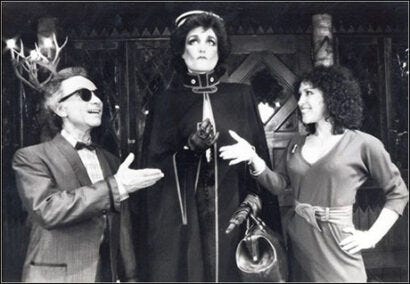
Now, you might be surprised that any actress would agree to even read a script for a show called Moose Murders. But when I receive a play, any play, I always try to give it a fighting chance. Even if it has problems, as this script obviously did, I assume that there will be extensive work done before the first preview. That is by way of explaining how I let myself get involved in Moose Murders, but I should also say that, in retrospect, the script read a lot funnier than it actually played. It had all the ingredients of a slapstick Abbott and Costello comedy. There’s the Holloway family: the matriarch, Hedda, a normal mother of a wacky brood; Stinky, her son, a stoned-out hippie; Lauraine, her neurotic, dimwitted older daughter; Nelson, Lauraine’s seemingly self-effacing husband; and Gay, a precocious, bratty little ten-year-old, who tap-dances incessantly. The patriarch of this family is Sidney, a mummified quadriplegic in the care of Nurse Dagmar, an overbearingly Teutonic sadist. This family comes to the Wild Moose Lodge in the Adirondacks presumably to find peace and quiet; instead they encounter murder, mayhem, and, even worse, “Indian” Joe, the caretaker (who is really an Irishman). They also run into the local lounge act, the Singing Keenes: Snooks, a tone-deaf singer, and her blind husband, Howie.
I was offered the role of Snooks Keene. I liked her. She was trashy and foul-mouthed but also warm, funny, and spirited. I have taken roles in failed plays before because I’d fallen in love with the part, and, as I am also a singer, I thought it would be interesting to play someone who is tone-deaf.
“You need this job, ” my agent said. “It’s a Broadway salary. There will be four weeks of rehearsals, one week of previews, and they want a nine-month commitment.”
“What? Broadway?” I was amazed. “I thought it was going to be an off-Broadway show.”
“What do you care? There’s more money on Broadway.”
“A Broadway show with only one week of previews? And a nine-month commitment?”
“Did you read the script?” he snorted. “It’ll never run. Take it.”
I was appalled. “Why? If it’s so terrible, why should I do it?”
“Because Eve Arden is going to star in it, Lovelump. And so is that little kid who was in Mommie Dearest. The show will get a lot of attention. Do it.”
Now, I’ve always adored Eve Arden. And I figured if she thought this script was funny and agreed to do it, I would certainly be willing to go along for the ride. Besides, I had just gotten off a long, bump-and-grind national tour as Sonia in They’re Playing Our Song. I wanted to stay in New York City—preferably working. Times are rough, I needed a job, a girl’s gotta make a living, you know what I mean? And so, not without trepidation, I signed on the irrevocable dotted line.
PART II—REHEARSALS
BEFORE THE FIRST REHEARSAL, we were all invited to a lavish party at the director’s elegant and expensive apartment. I met the entire company, including Eve Arden. While everyone else was nervous and jittery, Eve was self-possessed and dignified. A real lady. She seemed to adore her doting husband, Brooks West, and was always deferential to him. That night we talked about everything: being married, whether or not to have a child, her life in the movies and on TV. She never once said anything negative, especially about the play.
“Let’s take this to Los Angeles and then London. Wouldn’t that be marvelous?” I remember her saying. I agreed.
The next day we all met again, this time at the Minskoff Rehearsal Studios. As we read through the play the director, the playwright, and the associate producer shrieked with laughter. All the actors smiled confidently except the child from Mommie Dearest, Mara Hobel, who perplexed me. Child actors are rather terrifying: they act so self-controlled and seem to be grown up way ahead of their time. Mara just sat there, stiff and quiet. Eventually, when I brought her a chocolate E.T. lollipop and one of my clown dolls, she screeched with delight and threw her arms around me. In those initial readings there was actually a great deal of camaraderie and fun. But soon all that began to change.
At one rehearsal, Nurse Dagmar struck the quadriplegic in the head to make a point. This brought more screams of laughter from the director, the playwright, and the associate producer. In fact, their manic giggling had not stopped from the first day. As rehearsals continued actors were allowed to steal focus and not listen to or look at each other while the three continued to laugh, giving us a false sense of security. The associate producer laughed even harder. Some of us were told to go too far and pull out all the shtick we could find, while others were told to be real. It seemed to me that the director was terrified. We fought for rewrites on moments in the play that made no sense, but he and the playwright appeared to be deaf.
As Snooks, I had to do an interrogation scene in the second act to determine who the murderer was. I thought it might be fun if the character was drunk and, of course, made a mess of everything. I came in with some crazy ideas, like using as a prop a bottle of Scotch, and doing an imitation of Peter Falk as Columbo. It felt right, and I had a great time doing it. The director was incensed. “The play doesn’t work unless the interrogation scene is serious, ” he said. His voice assumed a nasal, quaky quality when he got angry.
“My play has to be taken seriously, ” the playwright chimed in. He was a foppish man whose head bent forward as if he were ashamed of his height. In fact, he was so angry, I was afraid he would cut my part down to nothing if I didn’t stop arguing with him. I only wish that he had.
Meanwhile, Eve, who all along had been strong and cheerful, began to seem ill at ease and have difficulty remembering her lines. So it became necessary to improvise around her. I remember at one point Eve, assuming that the Keenes were gypsies, was supposed to say to me, “Where is your caravan?”
Instead she said, “What is your cadenza?”
I knew cadenza was some sort of musical term, but I wasn’t sure what it meant, so I started to giggle and said, “Huh?”
I could see her eyes rolling around and around in her head, like one of those cartoons. Then she turned to her son and said, “Stinky, do not call your little sister ‘man.’ It could be . . . uh . . .” Her eyes began to roll. “It could be . . . pneumatic.” (The word intended was traumatic. )
It was no surprise to me that she was having trouble; she had been confiding to me from the beginning that she was upset that there had been no rewrites on the play. For the most part she persevered, but at one particular run-through she finally just stopped.
“Stinky . . . ” she said to the actor playing her son.
“Stinky, uh . . . uh . . . ”
She was trying to concentrate on the scene, but a million things were going on around her at once. Nelson was dropping the luggage, Lauraine was dropping her umbrella, the nurse was wheeling in the quadriplegic, and Stinky kept trying to kiss her. Mara Hobel was also doing her Shirley Temple tap routine, and the noise was deafening.
Eve turned away, exasperated. "Excuse me, I just have to stop,” she said and walked out of the room.
The director sat still, his eyes downcast. We all stood around in silence. I felt like Olivia de Havilland in The Snake Pit. My gaze wandered over to the window, beyond which I could see the offices of The New York Times, which were directly across from the rehearsal room. I imagined Frank Rich, the Times drama critic, his feet on his desk, looking at us through a pair of binoculars, a cigarette dangling from his mouth. He was convulsed with mocking laughter.
At this point I decided to talk to the associate producer, Rieka Kanter Fisher. Rieka Kanter Fisher is as intense as her name suggests; she is a small woman with an aggressive jaw who purses her mouth as she speaks and smiles through clenched teeth. I approached her cautiously.
“I may be talking out of line, but please, please postpone the previews. We need tryouts, rewrites, and more time. Eve is uncomfortable and upset and—”
“June,” she said, “we know what we’re doing. We won’t open if we’re not ready. We’ll never let you make a fool of yourself. You’re not producing this show, we are.”
Now, this was a curious statement, because I had been wondering exactly who these producers were. Beyond calling themselves Force Ten Productions, which I had understood to be a serious group of video and cable TV people who were well-financed by Texas oil money, they had never really identified themselves. Eventually I found out that, despite the director’s involvement with off-Broadway theater and such other enterprises as the movie Paradise Alley and something called Hunted, Moose Murders was what might be called a vanity production. Force Ten Productions included the director and the director’s wife—whose family was rumored to have put up most of the money—and Rieka Kanter Fisher, who, it seemed to me, was there to take the flak for them.
Of course, by the time I discovered all this it was too late to bow out of the project.
PART III—THE PREVIEWS
I’LL NEVER FORGET THE FIRST preview. Actors wandered around onstage aimlessly. People in the audience complained that they couldn’t hear us—which was no surprise, considering we were competing not only against Mara Hobel’s deafening tap dance but against a continuous sound track of rain and thunder as well.
If the people who come to the first preview of any show tend to be out for blood, they surely got their fill that night. Because they simply could not believe what they had seen the first time around, the same people came back the next night, bringing ten friends with them. By the end of the second preview they were hooting and hollering; some were even hissing.
The next day I returned to the theater with my mink coat flung around my shoulders, a little shopping-bag dinner of sushi, and my two dogs. I was told to go home. Sure enough, I looked up on the marquee and Eve Arden’s name had already been painted out.
With Eve’s departure I had hoped the show would close, but we were soon called back into rehearsal for a pep talk. We were told that Eve Arden had been the cause of the play’s problems.
“Now that problem has been solved,” said Rieka Kanter Fisher through half-closed eyes, “by mutual consent of both parties.”
We all knew that Eve had been desperate to get out of this awful situation, but no one said anything. The replacement, we were told, would be Holland Taylor, an effervescent, warm, thoroughly professional actress.
“Holland’s not a name like Eve Arden," said the director, “but she’ll better serve the needs of the play.”
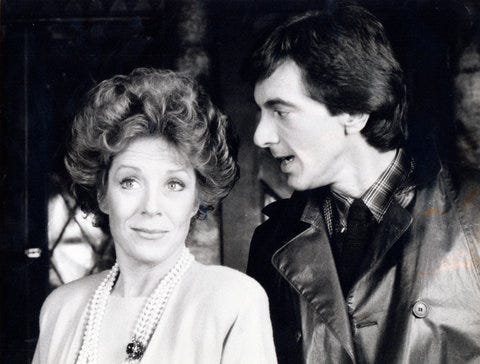
When rehearsals resumed with Holland, we were working at such a fast and furious pace that none of us had time to think. In two days Holland was “off book” (she had memorized her lines) for the first act, which astonished all of us. She infused us with a “let’s pull this all together” spirit, but when she started to ask some questions, she and the director soon locked antlers. One day the run-through came to a dead halt. Holland turned to the director.
“Who kills my daughter?”
We all became silent. The director blanched. “I . . . I . . . I don’t know,” he stammered.
She looked over at the playwright. He looked away. She looked back at the director and he finally looked up at her with an abstract smile.
‘“Well . . . Nelson kills Lauraine . . . I think,” he ventured. I couldn’t tell if he was serious. “Anyway, that’s not important. This is a farce.”
“It certainly is, ” I said.
Then, at another rehearsal, things came to a stop again.
“Why does my son have to stare into my goddamn eyeballs so much?” Holland barked out at the darkened theater. “He’s pawing me so much that I can’t move.”
The actor playing Stinky took offense, and while the two of them were tussling with each other, the director sat silent, brooding. He wasn’t saying very much these days. He also didn’t say anything when Nurse Dagmar and my blind husband, Howie, grabbed each other during the interrogation scene with such heartfelt intensity that I was convinced they were feeling each other up. This time I stopped the rehearsal.
“Snooks would not take that, ” I said. We were told to continue the scene. Enraged, as Snooks, I went over and threw Nurse Dagmar to one side of the stage and my blind husband to the other. They turned on me in fury. Don Potter, who played Howie, marched directly over to me and hit me on the head. I grabbed Howie by the collar as Nurse Dagmar came toward me from the other side.
“Uh . . . uh . . . ” finally came the response from the darkened theater. “I think that’s about all for now.”
The first preview with Holland was simply depressing. It was a great relief when we got to the last scene. As written, Hedda Holloway is supposed to offer her child a poisoned vodka martini with a twist. The child drinks it, falls down on the floor, and the curtain follows immediately. But at this performance the curtain just never came down. We stared at the audience. The audience stared at us. Still no curtain. Finally the production stage manager yelled, “Take down the lights.” We started groping our way offstage, bumping into one another and the furniture, when suddenly the lights came up for the bows and we were all caught wandering around the stage in total confusion. Needless to say, there was no applause.
By this time I’d started to have nightmares. I dreamed I was falling through a big black hole, with furniture, lights, and moose crashing down after me. I resembled a wild-eyed Shelley Winters as she hurtled herself through the ship’s floor in The Poseidon Adventure. I began to enumerate lists of diseases I could develop to check myself into a hospital and get out of the show: Tubular pregnancy? Heart failure? Kidney stones? Herpes?
My agent remained calm. “Don’t be ridiculous, ” he said. “Your name would be mud. Who do you think you are, Eve Arden? You can’t walk out now. You have to see this thing through.”
It became increasingly difficult to perform, and after each preview performance I just sat morosely at my dressing table in a ridiculous blond wig, my false eyelashes and false boobs drooping. My friends who visited backstage either stood around in sympathetic silence or laughed uncontrollably. Alice Drummond, a lovely actress and one of my dearest friends, came into my dressing room laughing so hard that she couldn’t speak. So did Orson Bean. “It was so terrible I had a great time,” he roared. Some were philosophical, like my hard-nosed agent. “Forget it,” he said. “Take the money and run. But just make sure that you get out of town after opening night.”
At one Saturday matinee performance we really hit rock bottom. The director had called an early “note” session before the show, so there had been no time to put on my complete makeup. My wig had just been washed, and it was a mess. The sound of the rain in the first act was so loud we had to scream out all our lines again. The audience also was very strange. I imagined Rieka Kanter Fisher herself had personally bused in all the schizophrenics from mental hospitals around the city. They fought loudly over their seats after the curtain had gone up, they yelled to each other from different sections of the theater, there was a terrible odor emanating from somewhere in the orchestra, and the show never got a laugh, except once: when the actor wearing the moose head got socked in the groin.
During the first act we were all joking about it backstage. Then, at intermission, the house manager came back and smiled at me.
“You better do well today, ” he said. “All of them are out there. ”
“All of who?” I asked, but I knew the answer. “The critics,” I moaned. “All . . . of . . . them . . . are . . . out . . . there. ”
Then the panic set in. I raced back onstage and tore through the second act. What made me so angry was that no one had told us that critics were in the audience.
“The producers just wanted to save you stress,” said Rieka Kanter Fisher sweetly.
PART IV—OPENING NIGHT
MOOSE MURDERS OPENED ON February 22, 1983. Flowers clogged the hallways and stairwells of the Eugene O’Neill Theatre. Flores para los muertos, I muttered as I made my way through all the flora and fauna to my dressing room. I remember getting a prophetic yellow rose from Rieka Kanter Fisher that stayed closed and never bloomed, along with a note, which read “Here’s to a long run at the Wild Moose Lodge.”
During that performance, disaster was evident everywhere. The entire balcony was empty. They had just managed to fill the orchestra, but even there the audience was less than enthusiastic. There were isolated pockets of applause and laughter. The play was well received by friends and relatives of the playwright, the director, the director’s wife, and the ubiquitous Rieka Kanter Fisher.
At the opening-night party at Sardi’s the atmosphere was jubilant. I kept my mink tucked under my arm, worked the room once, received kisses, smiles, and handshakes, then went to the bar to order my first stiff drink. Carefully I checked my watch, noting that in fifteen minutes Stewart Klein’s review would appear on Channel 5. Being knowledgeable about these particular parties, I got ready to leave, because after word of the reviews gets around, people jam the elevators and make a beeline for the door. Those that remain usually weep or move, trancelike, toward sharp, pointy objects.
On my way out I stopped again at the bar. I ordered a second double martini, swallowed my drink quickly, and, without looking behind me, beat a hasty retreat into the cold night air.
PART V—THE MORNING AFTER
THE FOLLOWING DAY THE REVIEWS were public knowledge. Everyone was talking about Moose Murders. I got condolence cards and huge wreaths of flowers, and the phone wouldn’t stop ringing. One of those calls was from Rieka Kanter Fisher.
“June,” she said, “as you know, we’ve decided, after long deliberations, to close the show.” There was a heartfelt sigh on the other end of the phone. “They just didn’t understand the play. They didn’t get what we were trying to do.”
“I’m so sorry,” I replied tactfully. “But surely in hindsight you must see why this happened, where the mistakes were made—”
“Oh, please,” she cut me off sharply. “Spare me this, June, could you? We were newcomers, that’s all. They wanted to destroy us. Please pick up your things at the theater no later than tomorrow.”
I hung up, feeling pretty grim. I would learn from all this, but would Rieka Kanter Fisher and Force Ten Productions? Despite everything, I had liked these people: they had really meant well.
“We just wanted to create good theater,” she had said, “and they shot us down.”
I went to the theater to pick up my makeup. It was a cold, damp, drizzly day. There on the steps was young Mara Hobel, her eyes filled with tears. I took her upstairs to my dressing room and tried to cheer her up while I packed my things.
As I left the theater I saw the director’s wife and her chauffeur loading all her things into a sleek black limousine. “It’s all right, June,” she said to me softly. “It’s all over.” The limo drove off, and I felt a twinge of envy. She can suffer in such comfort.
Recently I had dinner at Joe Allen with a friend. Craig, the maître d’, beamed at us as we entered. “We have a special table for you,” he said, taking my arm ceremoniously, “the Gable Table. ” He led me over to a comer of the room. There on the wall hung the poster of Moose Murders. My first reaction was to run. Then I laughed. I sat down and had a delightful dinner. We ordered champagne.
Like Tallulah in Lifeboat, I had stayed afloat. What’s more, I still had my mink. I toasted the moose: “To survival.”