Beyond method acting
On the Jonathan Miller "Long Day’s Journey into Night" & other matters.

By Mimi Kramer for The New Criterion, September 1986
. . . the playhouse . . . was little more than a shell. . . . Through the planks of its floor at high tide the bay could be seen and heard and smelled. Under Cook’s direction an ingenious stage was built. Only ten by twelve feet, it was sectional and mobile and could be slid backward onto the end of the wharf through the two wide doors at the rear of the theater, to provide an effect of distance. Those doors, through which fishermen had once hurled their catch, could be flung apart to expose the most realistic sea backdrop any theater ever had. . . .
—description of the Provincetown Players’ Wharf Theater from Arthur and Barbara Gelb’s biography of Eugene O’Neill
Certainly, one of the infallible signs that Coarse Drama is going on is the fact that the traditional roles of actor and audience are reversed. The actor is being himself while the audience are playing a part. . . .
—from Michael Green’s The Art of Coarse Acting
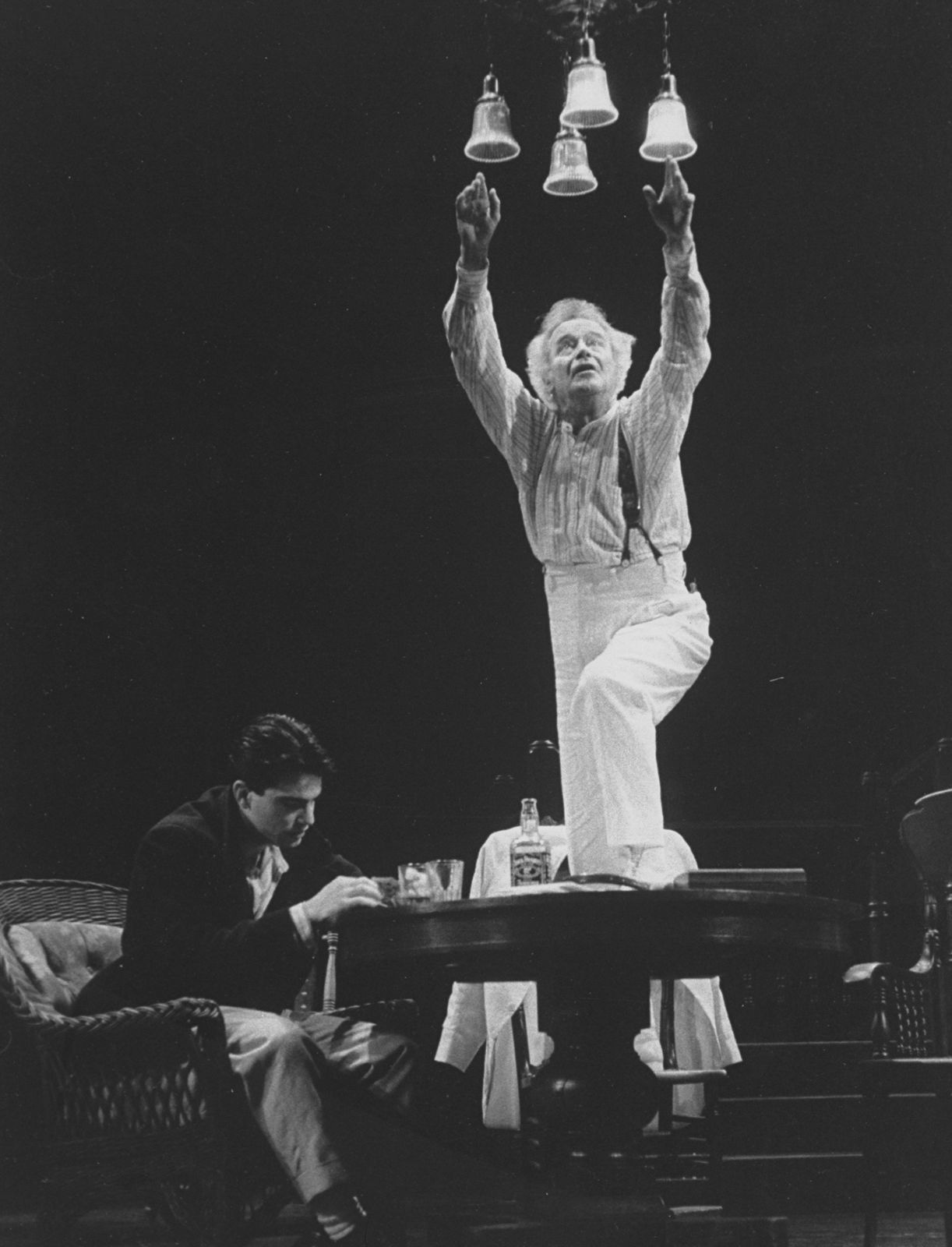
It says in my notes for the evening of April 29, “‘It’s a little late in the day for regrets’”—which isn’t exactly the line that James Tyrone is meant to deliver in Long Day’s Journey Into Night. Whether those are the words Jack Lemmon actually uttered on the stage of the Broadhurst Theatre that night or simply the ones I heard, I can’t say for sure. They’re what I wrote down; and next to them, in parentheses, I seem to have added the statement, “I’m close to tears.”
The experience of being moved in a theater isn’t the sort of thing you forget—meaning it isn’t the sort of thing you generally need to write down. So coming across the entry, some days ago, I was momentarily at a loss: I couldn’t think why I’d made it. I had to go back to the play and find the reference, and even then it was a minute or two before I remembered.
Tyrone had been telling his younger son Edmund the story of his acting career.
That God-damned play I bought for a song and made such a success in—a great money success—it ruined me . . . . I didn’t want to do anything else, and by the time I woke up to the fact I’d become a slave to the damned thing . . . it was too late. They had identified me with that one part, and didn’t want me in anything else. They were right, too. I’d lost the great talent I once had through years of easy repetition . . . .
It’s the speech that makes casting an actor like Jack Lemmon in the role of Tyrone so dangerous, for the story he tells is not all that different from Lemmon’s own. Fortunately, though, Tyrone’s speech isn’t really about acting: it’s about money, the character of the miser, and the forces driving him on—an insatiable fear and longing. “What the hell was it I wanted to buy, I wonder . . . .” is the line that comes before the one I wrote down. I can call nothing back now of whatever emotion made me pick up my pen, but I remember thinking I’d better get something down.in a hurry because memory is a funny thing, and weeks later I might not remember that Jonathan Miller’s Long Day’s Journey Into Night had been something that good.
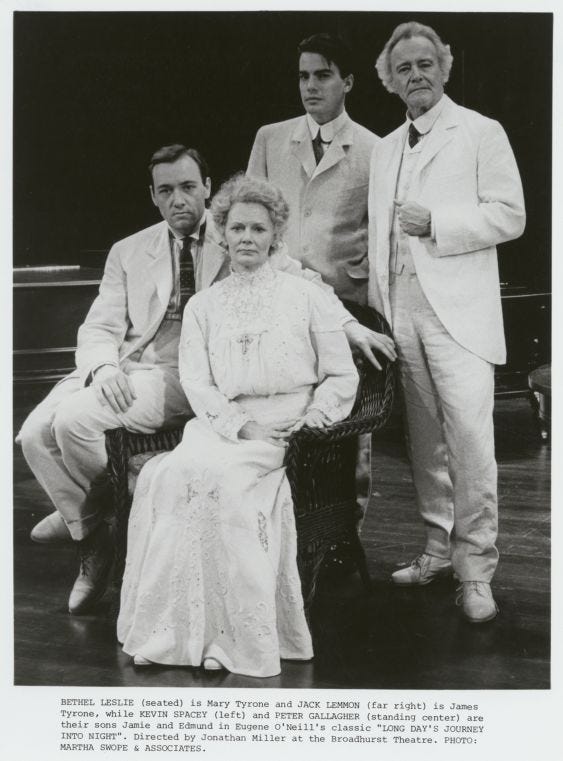
Jack Lemmon’s performance as James Tyrone was nothing less than a miracle, but not because it was great. The miracle lay in the fact that for once the actor wasn’t playing himself. Unfortunately, he wasn’t really playing anyone else. Great performances came from Kevin Spacey and Bethel Leslie as Jamie and Mary Tyrone. But Lemmon’s performance suffered from the same thing that dogged Jessica Tandy’s Amanda Wingfield two seasons ago: the star’s reluctance to portray a character less sympathetic than himself. Miller had got Lemmon to shed his mannerisms—the wince, half-grimace, half-stammer, and half-hitch turn of the head that make up his acting persona, that familiar mask of amiable integrity; what Miller could not get him to shed were the amiability and integrity. Unfortunately, James Tyrone is not an amiable or responsible man: meanness and childish vanity are his salient characteristics. But while it was endlessly possible to sympathize with Lemmon’s Tyrone, it was never possible to dislike him—which left a sort of gap at what should have been the play’s core.
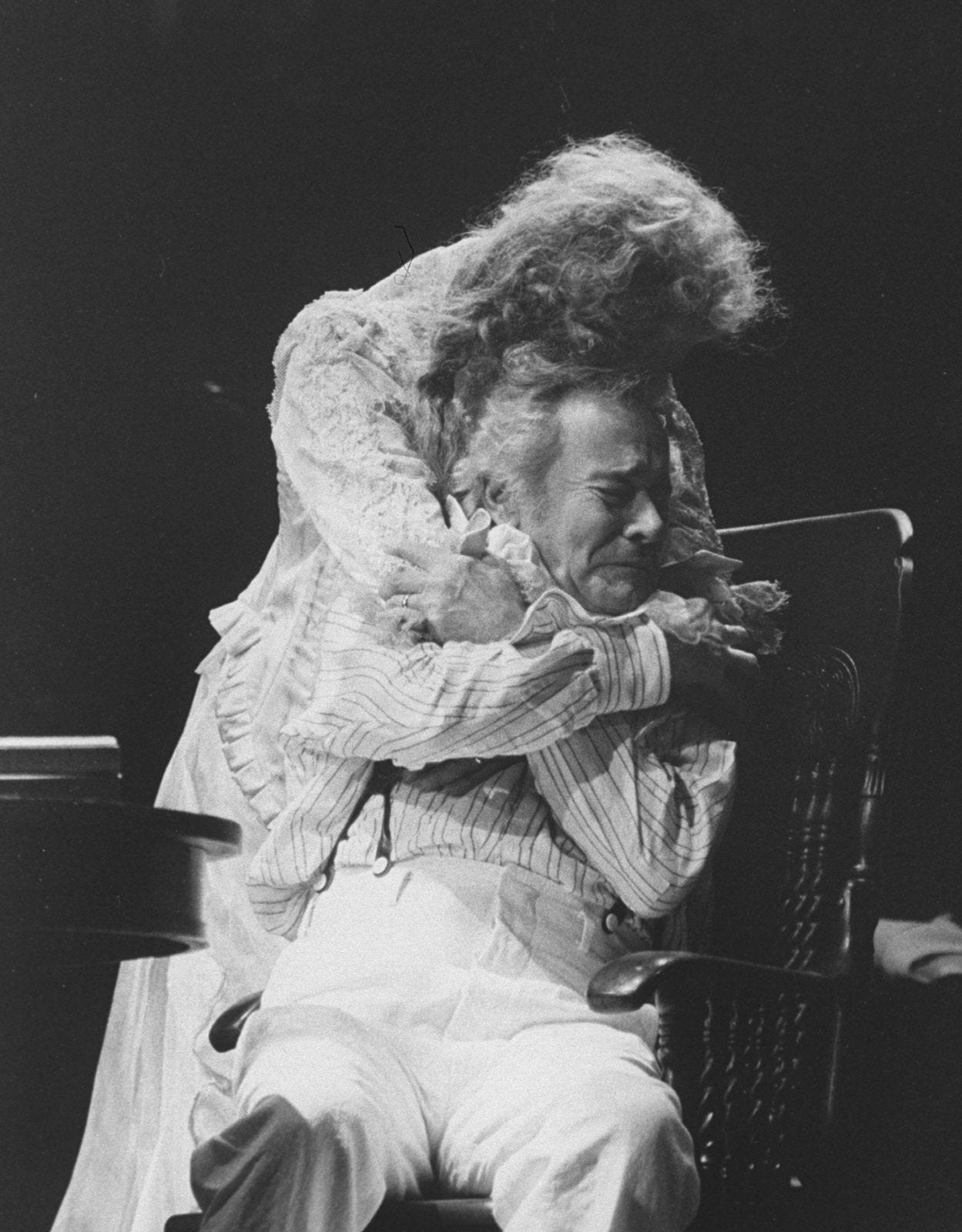
Still, if Lemmon’s performance didn’t rise to greatness, nearly everything else about Jonathan Miller’s production did: the set, for instance, and the way it cleverly evoked in the Tyrone’s living room the way-station feeling that everyone in the house keeps complaining about. The room was dominated by a massive staircase and grand piano, both of which seemed to be beckoning us toward the door, and between each scene the lights dimmed out on an uninhabited stage. Especially good were the liberties Miller had taken with the text of the play, the overlapping dialogue and all the chopping and changing he’d done. Purists, I know, will object. I’m told of an O’Neill scholar who wrote to the Times to protest the Miller production. And a friend reports that at the performance he attended a man rose from his seat at intermission and began to shout, “It’s not O’Neill!” Maybe it wasn’t. All I can say is that it was better than any O’Neill I’ve ever seen.
For me, O’Neill has always been an exercise in tedium: hours and hours spent listening to relatively unremarkable people hurl accusations at one another. It is the dominant topos in American realist theater—the Crisis of Family Revelations. Willy and his sons in the kitchen; Albee’s George and Martha hammering away at each other; the tetchy couple in The Dark at the Top of the Stairs. “Gee, Rubin, how come you slugged me just now?” “Well, Cora, I find it difficult to make love with you nattering on about money all the time . . . .” What has always seemed to me fundamentally unrealistic in American realist drama is the quality of revelation being made in these climactic sequences: the notion that no one would ever have said any of these things before. Jonathan Miller’s overlapping dialogue got rid of this problem. With characters talking across each other, and laughingly interrupting to finish off one another’s sentences, you knew that no one on the stage of the Broadhurst Theatre was saying anything they hadn’t all heard before, hundreds and hundreds of times. O’Neill actually wrote very few lines that wouldn’t benefit by having someone talk over them, so it isn’t as though there was that much damage to be done. In any case, most of the overlapping was done with lines that don’t really bear a solo delivery (or the ponderous, pause-laden treatment they tend to get from American method actors). In fact, though, you didn’t miss a word: instead, pressing forward in your seat—the way one sometimes presses forward to hear the unfamiliar strains of Shakespeare’s English—you found yourself listening more closely to what was being said, and hearing more.
The overlapping dialogue in Miller’s production did more to create a semblance of life than all the “stammering” and “faithful realism” of O’Neill’s fog people. The production as a whole, moreover, suggested something about what is wrong with American approaches to O’Neill in general. It’s the same thing that’s wrong with American Chekhov, that relentless insistence on presenting the world exactly as the characters in the play see it. Jonathan Miller’s Long Day’s Journey was good for the same reason that English productions of Chekhov are better than ours: he had his actors playing O’Neill for comedy, secure in the wisdom that all of the drama and tragedy would emerge of their own accord.
This earnestness, this consistent refusal on the part of American Chekhov to recognize the comedy in any of the characters or events being presented, is as much a function of method acting itself as of the aesthetic that produced it; for American naturalism emulates Stanislavsky in nothing so much as in his humorlessness. It is blind to irony, baffled by comedy and satire—but then, it was only ever interested in literal truth. American realism thought it had no more to teach us than the facts of how life is or how a particular character feels. Miller discovered something in O’Neill that few of us had ever dreamed was there: dramatic irony. He created a tension between our experience and the experience of the Tyrones and, in doing so, brought out a far more moving truth than any of the case histories, accusations, and incidents of the past that were flying about the stage. For what you actually heard, pressing forward in your seat, were all the little lies and half-truths, the inconsistencies and half-confirmations— the discrepancy between what people say and what their behavior indicates—that Long Day’s Journey Into Night is really about.
That an English director should have something to teach Americans about how to bring Chekhov to life, or late O’Neill, seems somehow ahistorical. After all, the realism of O’Neill was born of the same artistic impulse that has made Stanislavsky the dominant force in acting and stage direction in this country. And method acting itself was specifically invented to bring life to the plays of Chekhov: it was twinborn with them, by Stanislavsky, out of the Moscow Art Theatre. If there’s anything we Americans ought to be able to do better than the English, it’s Chekhov and late O’Neill.
Jonathan Miller’s production of Long Day’s Journey Into Night was an indictment of the dominant aesthetic underlying American theater. Another indictment of that aesthetic recently came from a rather unexpected quarter: a book about acting written by a group of young American actors. Published by Random House last spring, A Practical Handbook for the Actor is just what it sounds like: a how-to book that seeks to demystify certain aspects of the acting profession. To the general reader it is of interest less for the specific advice it offers than for what that advice suggests generally about where we have come to in our practical thinking about the nature of theater. According to its six authors—Melissa Bruder, Lee Michael Cohn, Madeleine Olnek, Nathaniel Pollack, Robert Previto, and Scott Zigler—the book grew out of an exercise their teacher, the playwright David Mamet, had assigned them during a number of acting workshops that he has conducted at various times in New York, Chicago, and Vermont. The authors have since formed a group called the Atlantic Theatre Company which operates out of Chicago and Vermont. (I don’t know why Vermont keeps coming into it: I imagine somebody’s father had a barn.)
Of course, there is no dearth of textbooks for the aspiring actor. What’s interesting about this one is that it represents the testimony of fourth-generation American actors—actors who will have been taught by students of the students of the disciples of Stanislavsky. In view of who they are, what they have to say is a little surprising: they say that it is impossible for an actor to become the character he is playing, that becoming the character is not even an actor’s job; they say that character is “an illusion created by the words the playwright has written” and, for the purposes of performance, “exists only on the printed page”; they say that the actor need never “gear up emotionally for a scene,” that the concept of “emotional preparation” is one he “need not bother with”; they say, in fact, that the actor is onstage not “to have an experience . . . but to help tell a story.”
From the standpoint of American method acting, all this is blasphemy. Method acting believed that the actor’s primary obligation is to be faithful to nature and psychological truth—a revolutionary idea back in 1897 when Konstantin Stanislavsky and Vladimir Nemirovich-Danchenko first met and founded the Moscow Art Theatre. What they were chiefly rebelling against was the kind of theater that James Tyrone is talking about in Long Day’s Journey Into Night, in which audiences flocked to see, not art, not acting or a play, but a familiar performance: a famous actor playing a famous role in a famous way. Stanislavsky and Nemirovich-Danchenko looked at the artificial, declamatory style of nineteenth-century theater and concluded (rightly) that the behavior of the stage actor had nothing to do with the way people really behave, that representation of emotion in the romantic theater had been reduced to a repertoire of stock attitudes and gestures: this pose for grief, another for fear, still another for anger or surprise.
Stanislavsky’s answer was to reject the idea of representation of emotion altogether. His “system” asked the actor to strive for real feeling, rather than to affect the semblance of an experience or emotion. It wasn’t enough to feign sleep: you had to lie there remembering the sensation of feeling sleepy. It wasn’t enough to present a heartrending picture of starvation: you had to remember what it actually feels like to be hungry. It wasn’t enough to manifest depression, to shed tears, even—you actually had to feel sad. Any suggestion of artifice in acting was anathema to Stanislavsky. The very concept of simulation smacked of emptiness and charlatanism. Method acting sought to put onstage not an image of reality but reality itself. For Stanislavsky, illusion was a dirty word.
It is blasphemous for the authors of A Practical Handbook for the Actor to speak of the “illusion” of character, to treat it as a literary or artistic construct. It is blasphemous for them to suggest that speculating on how a character might take his tea or blow his nose, what kind of underwear he would sport, “does not create a life” in the actor. Method acting taught us to go below the surface of the costume or the words on the page. It taught us to follow the character home and ruminate on the details of his offstage life and past—his childhood, his dreams, anxieties, and disappointments. It taught us to live the role rather than just portray it. So it is blasphemous for these upstarts to say that actors can never become the characters they play. For method acting, becoming the character was the whole point.
To appreciate how extraordinary it is for these actors to be saying the things they’re saying, you have to know something about how pervasive the teaching of method acting has become in this country, and the kind of influence it exerts on the minds of its children. “Most acting training is based on shame and guilt,” says David Mamet in his (characteristically brief) introduction to A Practical Handbook for the Actor:
If you have studied acting, you have been asked to do exercises you didn’t understand, and when you did them, as your teacher adjudged, badly, you submitted guiltily to the criticism . . . . As you did these exercises, it seemed that everyone around you understood their purpose but you—so, guiltily, you learned to pretend . . . .
There’s a nice little song on this theme from A Chorus Line: it tells of the humiliation and degradation that an aspiring actress, Morales, suffers at the hands of an acting teacher at the High School of Performing Arts because she feels “nothing” while playing theater games. Her revenge, on hearing later that the teacher has died, is to feel “nothing.”
Morales doesn’t refer to any specific technique or approach to acting. She doesn’t have to. David Mamet never mentions “method acting” by name, or Viola Spolin’s improvisational theater games. Neither do the authors of A Practical Handbook for the Actor. The point is that you don’t need to have studied acting professionally to be familiar with these things. Method acting and theater games are what you learn when you study acting just about anywhere in this country. You learn to think that you are smelling burnt toast or coffee or gasoline when none is there. (This exercise is to develop your “sense memory.”) You learn “the mirror game,” where two people stand face to face and take turns trying to mirror one another’s movements exactly while looking only into one another’s eyes. (This exercise is to develop your “peripheral vision.”) You learn to stand in the middle of a circle, fall stiffly backward, and pray that another actor will catch you. (This exercise is to develop your sense of “trust.”) You lie on the floor while someone talks droningly about a “magic cloud” passing overhead and you learn to believe that each part of your body the cloud passes over has become too heavy to lift. (I never knew what this exercise was for.) You learn to do “substitution improvs,” where you follow a character through a succession of situations, becoming (clap!) now Joan of Arc babysitting for the neighbors, (clap!) now Joan of Arc at the junior prom, (clap!) now Joan of Arc in a lifeboat. Junior proms and lifeboats figure prominently in the minds of method acting teachers, so, over the years, you learn a lot about how various literary characters would behave in boats (Hedda Gabler? Ophelia? Dracula?) or on a first date. Method acting—or some version of it—is what you tend to learn when you study acting in this country, because it’s what most people who teach acting were taught themselves.
Method acting was what was taught at the small liberal-arts college I attended in the mid-1970s, and it was taken very seriously indeed. To walk into the “professional” theater at Swarthmore was like walking into bedlam: in every corner writhed a theater major and the air was filled with the cries of actors coming to terms with themselves, echoing like the shrieking of the damned. I’d pretty much had my fill of this sort of thing when I got to Swarthmore, so I kept away from the acting side of things, for most of the time—until, in my senior year, I took part in a theater-department production of Arms and the Man.
A friend was directing the play as part of a final project in a directing course and for some reason had been allowed to cast actors from outside the department. Only one member of the cast, in fact, had come from within the department, a fellow named Luigi. He was playing the part of a soldier in the first act. As the lady of the house I had to usher him on- and offstage. He was an intense young man, eager to do a good job, and shortly after rehearsals started, he came to me with a suggestion: he was having trouble with his inner monologues, he said, and thought we would do well to invent a little offstage dialogue to go through when I came offstage to get him.
Later, I used to get a lot of mileage out of that story, particularly in theatrical circles at Oxford: people would fall about laughing and I’d laugh with them. But I was raised on method acting. It’s what I was taught. And I always thought someday a terrible judgment would be visited on me for laughing at Luigi—I’d be struck dead or the god of theater would send a basket down for me. Even now, I can’t help feeling it is wrong to laugh at Luigi. And it is wrong—wrong and flippant: Luigi only wanted to do a good job and to mock him strikes at the root of method acting’s most fundamental beliefs. Stanislavsky said: “There are no small roles, there are only small actors,” a tenet without which professionalism in theater cannot exist. All the same, I can’t help thinking that anyone who requires elaborate psychological mnemonics to deliver four lines onstage belongs in some other line of work.
I had the same feeling reading A Practical Handbook for the Actor I used to get when talking about Luigi. It was a little like reading a dirty book, in fact, I kept thinking someone was going to come in and take it away. I should stress, though, that A Practical Handbook isn’t written to shock. It isn’t at all an angry or contemptuous book. The authors are not dismissive of Stanislavsky: they quote him respectfully and recommend his writings. Only in the sous conversation does one hear the same whisper of generational conflict one heard in the opening sentence of Mamet’s introduction. It’s not the voice of revolutionaries, burning their Equity cards and calling brother actors to arms. It’s more like children secreted off in a room together: the oldest ones are telling the others about grown-ups—what they will say and how much of it to believe.
More than anything else, what one senses about these actors, reading their book, is that they feel method acting has failed them because it has failed to teach them what they want to know. Well, method acting has failed. It has failed us all. To appreciate the extent of its failure, one need only attend a performance by one of the grandes dames of the New York “method” stage. Uta Hagen’s performance as Kitty Warren, this year, in the Roundabout Theatre’s production of Mrs. Warren’s Profession was an embarrassment: she couldn’t sustain a consistent character, let alone sustain a consistent accent. In the course of the evening she “became” eight or nine different people, none of whom had anything in common with one another except a grand actress manner, or anything in common with humanity except a certain resemblance to Uta Hagen. Her disciple, Geraldine Page, is another terrible actress. New York audiences have seen quite a bit of Miss Page recently—not only in Sam Shepard’s A Lie of the Mind but in all those plays the Mirror Repertory Company has produced in the last few years—and whether she is playing Sam Shepard, Clifford Odets, or Jean Giraudoux, her performance consists of trotting out the same vocal and physical mannerisms that characterized her acceptance speech at the Academy Awards this year. Whoever Geraldine Page “becomes,” she is always herself.
But that’s the joke about method acting. It has ended by reproducing all of the things it set out to correct in nineteenth-century theater: the staginess and inflexibility, the concept of the self-serving star. Look at the roster of “great” method actors: not only Uta Hagen and Geraldine Page, but Marion Brando, Marilyn Monroe, Montgomery Clift, Karl Maiden, Julie Harris, Jason Robards, Eli Wallach, Ben Gazzara, Shelley Winters, and—yes—Jack Lemmon, all of them actors who cannot act, who can only “live truthfully under the imagined circumstances”—as themselves.
It’s a painful thing to have to admit. After all, the experience of being moved in a theater—any sort of theater—isn’t the sort of thing you forget. There is no one who has not been moved by one of these actors, who will not flinch at the mention of one or another of these names and think inwardly, “Oh no, not him!” or “Not her!” Some of Jack Lemmon’s screen performances, for instance, are very dear to me—Some Like It Hot, Mr. Roberts, The Fortune Cookie, Days of Wine and Roses—so I think about crossing out his name. Next minute I think about crossing Brando off the list because of his smile at the end of The Wild One, or Marilyn Monroe because of the “toothpaste” speech in Some Like It Hot, or Julie Harris because of the ferris-wheel scene in East of Eden, or Shelley Winters because of Lolita. All of these actors have given great screen performances. Or rather, like the current generation of method actors—Dustin Hoffman, Al Pacino, Jack Nicholson, and Robert De Niro—all of them had in them one great performance, which made them famous and to which they remained faithful. The way James O’Neill remained faithful to the role of Edmund Dantès in The Count of Monte Cristo. Today audiences flock to see Al Pacino, Dustin Hoffman, and Robert De Niro onstage in much the way the nineteenth-century audiences must have flocked to see Eugene O’Neill’s father. Method acting didn’t eliminate artificiality in stage acting, it only updated it, giving rise to a more individual style of mannerism. It didn’t teach the actor how to be a chameleon, either, merely how to turn every character into himself.
Inevitably, one wants to know to what extent this failure can be attributed to Stanislavsky himself. How far is American method acting a reflection of what he actually believed and taught and, practiced? Indeed, what accounts for his extraordinary influence on American theater in the first place?
That method acting gained a kind of foothold in this country which it never established in England has partly to do with a national temperament, I think, and partly with the spirit of a time. Stanislavsky’s preoccupation with “truth” has always appealed to the American character: we wear our sincerity the way an old soldier wears his scars—fondly and with the satisfaction of remembered pain. But the kind of photographic realism that method acting was after would also have been in keeping with the sensibility that governed the period in which “serious” theater was first emerging in America. Actually, Stanislavsky’s influence on American theater has a precise analogue in the importance that Brecht would come to have for a generation of British playwrights and directors following the Berliner Ensemble’s visit to London in 1956. The Moscow Art Theatre had come to New York in 1923 and made a tremendous impression on the intellectual and artistic community. When Harold Clurman and Lee Strasberg were founding the Group Theatre in the late Twenties, it became one of their aims to train a permanent company according to the principles of Stanislavsky’s “system.” In a sense, method acting is with us because Harold Clurman and Lee Strasberg invented “serious” theater in America and method acting was what they were interested in.
The first question is more difficult to answer. American method acting stands at a distance of fifty years, many ocean crossings and several theatrical generations from Stanislavsky: his doctrine has suffered as all doctrine must when it is carried far from home. Certainly there are whole aspects of Stanislavsky’s “system” that American method acting only ever paid lip service to, and others that fell by the wayside: the rigorous vocal and physical training, for instance, which Stanislavsky always stressed as being an indispensable part of the actor’s “preparation” was gradually replaced in this country by the improvisational theater games which emphasized self awareness, self-discovery, and self-expression at the expense of technique.
No one would argue that what gets taught today under the general heading of “method acting” has much to do with Stanislavsky’s “system”; but it’s difficult to know exactly which idea or which distortion of which idea crept in where, when, or with whom. What Lee Strasberg, Harold Clurman, and Stella Adler first taught at the Group Theatre was what they had learned from two disciples of Stanislavsky, Maria Ouspenskaya, and Richard Boleslavksy—former members of the Moscow Art Theatre who had come to New York to found the American Laboratory Theatre in 1922—or rather, what they thought they’d learned; for one thing the disciples of Stanislavsky have never agreed upon is what he actually meant.
There is, moreover, a vast discrepancy between what is written and what is actually taught. There are tenets no method actor would ever admit to that he nevertheless holds. Method acting has always maintained a fundamentally hypocritical stance toward the mechanics of theater, for instance: publicly it acknowledges the need for a playwright, an audience, and a director; privately it deplores them and holds them in contempt. But no method actor would ever admit this. In fact, few method actors would admit to being method actors. Dustin Hoffman probably wouldn’t. Uta Hagen certainly wouldn’t. Yet method acting is certainly what Hoffman practices and what Hagen preaches in her widely read book Respect For Acting. It is what she and Herbert Berghof have taught at HB Studio in New York for forty years.
Out of this morass of caginess and uncertainty one thing stands out: the importance of a dispute over the interpretation of “the method” that arose between Lee Strasberg and Harold Clurman in 1934. It centered on Stanislavsky’s concept of “Affective Memory,” the idea that in order to act a role, the actor had to draw on his own experience and emotional memory. Clurman and Stella Adler thought that Strasberg was making too much of this notion and, as a result, was encouraging actors to concentrate too much on self-discovery and not enough on an analysis of the play. So alarmed were they by what Strasberg was doing that in 1935 Stella Adler went to Paris to meet with Stanislavsky and ask him who was right. She came back to New York with the information that, according to Stanislavsky, they were: Strasberg was overdoing it with the emotional stuff; but Strasberg dismissed the verdict. In any case, the Group Theatre was having other problems at the time, and the controversy over method acting was interpreted as part of a power struggle between the two directors, which it may very well have been. (Strasberg had been the dominant force in the company since its inception in 1931.) Strasberg resigned in 1937 and the Group disbanded two years later. History records that, out of the controversy, it was Clurman who emerged the victor—because he walked off with Clifford Odets and Awake and Sing! But history seems to be wrong. Today it is Strasberg’s name we associate with the teaching of method acting, while “Stella Adler” is just an advertisement in Backstage and Clurman’s a name above a storefront theater that keeps changing hands.
It’s interesting to speculate on what American theater would be like today if something closer to Clurman’s version of method acting had become the one most commonly taught. For most of the evils of American method acting stem from that original distortion on Strasberg’s part of the concept of “Affective Memory.” The Clurmans really were right: Strasberg had given the idea an importance it should never have had. For Stanislavsky, “Affective Memory” had been one important element in a complex system—a sort of moral anchor intended to keep theater on the straight and narrow, ridding the stage of what was fraudulent or phoney. But equally important to Stanislavsky (at least in theory) was an analysis of the play that tied the actor’s emotional responses and extrapolations to some notion of context.
In Strasberg’s hands, the whole concept of “the given circumstances” fell by the wayside, for Strasberg taught the actor to bring to the role “the truth of his own emotions,” and nothing else. What Clurman and Adler could see that Strasberg could not was that in forcing the actor to draw always on the same wellsprings of character, experience and behavior, Strasberg was in danger of creating only another sort of actor who could not act. “What would I do if I were in that situation?” is the question the American method actor always asks himself; never “. . . and if I were somebody else, what then?” Strasberg’s approach to method acting had another, more serious consequence for theater: it made a mockery of the idea of the audience. For when the actor’s own feelings became the standard by which the validity of a performance was to be gauged, the audience ceased to be an entity upon which theater was supposed to have an effect. “How was that?” asks the naive method actor. The answers are always the same— “How did it feel? Did it feel right?”—until, finally, the method actor stops asking. He is no longer naïve.
Of course, some element of this attitude was implicit in Stanislavsky’s own thinking about the theater. He wanted the quality of life onstage to be identical to what you would see if the “fourth wall” of a house were removed. He wanted actors to be carrying on as if no one was watching, like ants at a picnic, oblivious to the little crowd of day-trippers observing their movements. Unfortunately, the quality of stage action has about as much to do with natural habit as life on the moon—and for the same reasons. The stage actor, inhabits wholly different worlds of space and time, owing to the physical conditions of theater. You cannot “talk normally” on a stage and hope to be heard; just so, you cannot behave normally onstage, just carrying on as though it were real life, and hope to have an effect on anyone but yourself. The fact is that an audience is there, a necessary part of the theatrical process if the experience of theater is to be anything more than make-believe.
When the Moscow Art Theatre came to New York in 1923 they brought with them four productions: Chekhov’s The Cherry Orchard and Three Sisters, Gorky’s The Lower Depths and Alexei Tolstoy’s historical drama Tsar Fyodor. This last had been the MAT’s first-ever production in 1899 and it was their pièce de resistance, a realistic extravaganza, remarkable chiefly for its fetishistic attention to realistic detail and historical accuracy.
In a famous essay in The New Republic, Stark Young raved about the Chekhov; about the other two productions he was more circumspect. He was decidedly unimpressed by the “quality of the performance” in the Gorky play, for instance, and he found Stanislavsky’s performance “the worst of all.” Young was even less impressed with the company’s showpiece. On Tsar Fyodor he wrote that he found “a complete air of human beings living there in the familiar ways of men,” adding, “but I cared nothing about it”:
I have no interest in poetry taken as prose, and almost no interest in history taken, but for its mask of antique trappings, as contemporaneous human life. For the truth of history seems to me to be a combination of actuality and remoteness. Of this sixteenth-century matter of men, equipage and event, the reality to me is the idea of it . . . . In other words, in the performance of an imperial ancient story like this of the Tsar Fyodor I should like the style of the acting to achieve not the studied naturalness that we take daily as the ways of men but the form, the magic of distance and scope, the conscious arrangement, the artifice and logic, that would create in my mind the idea. And with jewels and arms and clothes I can see merely correct history of them in museums if I choose; what I want on the stage is these things translated into stage terms, restated with that lustre and relief . . . that would make them “art.
“A combination of actuality and remoteness”: it’s as good a definition of art as any I’ve run across. What Stark Young, perceived as far back as 1923 was the basic distinction Stanislavsky had failed to make between nature and art.
I don’t mean to suggest that method acting served no purpose. If Stark Young raved about the Moscow Art Theatre Chekhov I’ve no doubt it was because he was seeing something he’d never seen before. But it is important to keep in mind how primitive the conditions of theatrical production were at the time of Stanislavsky’s and Nemirovich-Danchenko’s historic conversation in 1897. After all, one of the innovations they came up with during those eighteen hours of discussion was the idea of dimming the house lights. Stanislavsky wanted to rid the theater of an audience that sat there gnawing on chicken bones and chattering through the performance: his antidote was to adopt the fiction that the audience was not there. He wanted to rid theater also of the kind of actor that Michael Green describes in The Art of Coarse Acting, who tells his director, “ ‘Laddie . . . . These moves were good enough for Sir Barry Jackson in 1924 and they ought to be good enough for you.’” The solution, obviously, was to insist that every breath or action taken onstage have some organic justification.
Every artistic movement rebels against the one before it and, in accomplishing what it set out to do, ends by making itself obsolete. Unfortunately, method acting was obsolete by the time it began taking hold in America; for as the English director Tyrone Guthrie pointed out in 1956, the theatrical conditions against which method acting had revolted had already ceased to exist. Moreover, the hold method acting developed on the mind of American theater was out of all proportion to what it had to teach us: for most of the little tricks of auto-suggestion and emotional by-play it institutionalized are really so basic to the business of “playacting” as to be almost instinctive. It’s like what Olivier is supposed to have said to Dustin Hoffman: “Why don’t you try acting for a change, dear boy? It’s ever so much easier!” The truth is, that all actors “gear up emotionally” for a scene. They just don’t all make such a fuss about it.
No doubt I am overstating the case against method acting; but it is a case that calls for overstatement. Too much damage is being done, for one thing. By now the culture of method acting is moreover so deeply entrenched in American theater that to make any case against it is a little like crying for the moon. It’s been tried before: members of the theatrical community have been issuing caveats to us about method acting for years—not only Stark Young and Tyrone Guthrie, but others after them and before. In 1921, in an article in The Saturday Evening Post, David Belasco, one of the earliest proponents of American “realism” warned against the disastrous consequences of an actor’s over-identifying with his role, pointing out that “acting, like all arts, is symbolical.” Robert Brustein, in an essay in Third Theatre, warned against the “subtext” in method acting becoming “a stratagem by which the actor ignores the playwright’s meaning, substituting the feeling he himself finds to be more compelling.” In 1956 Arthur Miller actually spoke out against Lee Strasberg in The Paris Review, describing him as “a force which is not for the good of theater.” And in an essay in Tulane Drama Review, Robert Corrigan, former editor of that publication, warned that method acting had already had “insidious” effects and “may well have been harmful to the art of our theater.”
Corrigan’s essay is worth reviewing here. He describes method acting as “a two-edged sword that can do as much harm as good to the theater.” For, he writes:
. . . the Stanislavsky system, while it is the “only organic technique of acting in the modern theatre,” [Clurman’s words] has also tended to ignore the playwright and more often than not has transformed the director from one whose purpose is to order the production in such a way as to realize the playwright’s intention on the stage, to a coach of a kind of acting that is very often artistically beside the point.
According to Corrigan, “in his insistence that the actor always be true to nature” Stanislavsky taught his students
not how to act, not how to express the playwright’s ideas, but how to relive as fully and believably as possible a certain experience . . . . The Stanislavsky-trained actor, who comes to depend only on life, only on honest personal experiences and the believable representation of these experiences, very likely will fail to reflect and express that particular vision which the playwright is striving to communicate in his play. If the actor fails to perceive how the playwright’s intention transforms a natural incident into something else, then, no matter how truthful his representation of that incident may be, he will succeed only in giving the audience the event and not the author’s transformation of that event . . .
It’s essentially Stark Young’s point about art and nature, but Corrigan takes the occasion to resurrect what is probably one of the most widely ignored of best-known facts in theater lore: that Chekhov hated Stanislavsky, thought he was a perfectly rotten actor and director and always maintained that the Moscow Art Theatre misrepresented his plays. Corrigan’s point, specifically, is that Stanislavsky “failed as both an actor and a director (at least in Chekhov’s opinion) because he interpreted each role in terms of the role alone rather than in terms of the play as a whole.” Characters, in other words, whom Chekhov had meant us to see as comic or slightly absurd, had been taken at face value and on their own terms.
Which brings me back to Jonathan Miller, Long Day’s Journey Into Night and A Practical Handbook for the Actor. If the latest attempt at a revisionist view of method acting comes from a group of actors, I think it is telling that they have a playwright behind them—particularly this playwright. David Mamet is more a satirist than a realist—which isn’t to say that the characters he creates have no foundation in reality, but that they exist to serve a moral point. As a playwright Mamet is more interested in suggesting something about life than he is in merely representing it. You could not play a character like Shelly Levene or Ricky Roma (in Glengarry Glen Ross) completely from his own point of view, any more than you can play Chekhov’s Astrov in Uncle Vanya from his point of view—as the consummate method actor F. Murray Abraham tried to play Astrov in the Andrei Serban production at La Mama several seasons ago.
What the authors of A Practical Handbook seem to be after is that “combination of actuality and remoteness” that Stark Young talks about. They offer what is essentially a variation on the Stanislavsky approach to “scene analysis” that requires the actor to achieve some imaginative and emotional distance from the character he is playing and from the dramatic context. Still, it’s a mark of the strength of method acting’s hold on us all that even the authors of A Practical Handbook underemphasize the crucial importance of the analysis of a play and what they call the “through-action.” You can’t create Oedipus as a character without taking stock of why Sophocles chose the particular words he did in creating him in the first place, any more than you can play Shelly Levene without considering why Mamet bothered to create him in the first place and why he thought we would care.
A Practical Handbook for the Actor is a book that cries out for a second edition: too much of what the authors are trying to say remains unclear to the actor-reader, and it will need much revision and much feedback from other members of the theatrical community before the book can be usefully seen as a pedagogical tool. What the authors attempt to teach is so clear in their own minds that they have failed to anticipate many of the problems that will arise for anyone coming to it—as most actors will be—burdened by the instincts and assumptions engendered by years and years of method and pseudo-method acting training. Probably one of the best things that could happen to theater right now would-be for other actors to read the book and respond to it (as the authors invite readers to respond), offering insights into how their own experience either does or does not correspond with the approach suggested in A Practical Handbook. Let one of the theater publications like American Theatre or Drama Review start a dialogue between members of the theatrical community.
It’s a late day for regrets and you can’t reform American theater overnight. On the other hand, you have to try.