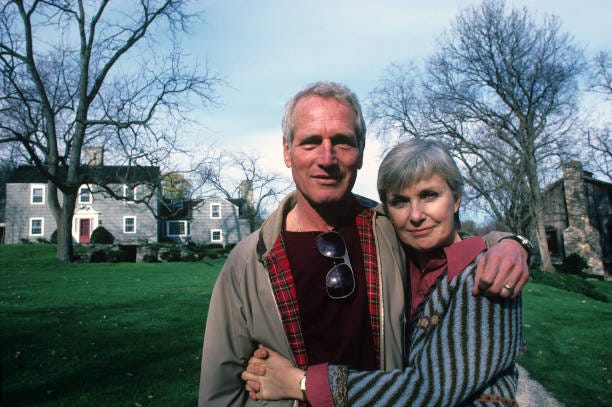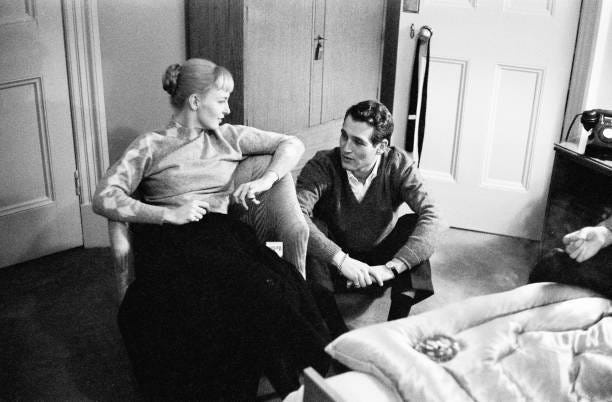
Paul Newman and Joanne Woodward met in 1953 during a production of Picnic on Broadway. My mother recalled seeing my father first in a casting office and joked that his absolute perfection was absolutely, “disgusting.” They would go on to work together opposite one another on film in The Long, Hot Summer in 1957. In the interim, the freight train of their attraction left all kinds of collateral damage in its wake, including a marriage and three children. His earliest love letters reveal a man helplessly besotted by a woman who, as an artist, was everything he was not. Free spirited, creatively fearless, my mother absorbed roles viscerally, organically, while our father tended to scaffold them with analysis. He once said that he sometimes preferred the process that came before a project more than the project itself, and spent a lifetime trying to unlock the “method” of Method Acting she accessed so intuitively. They married in 1958 as soon as my father’s divorce was final, and bounced back and forth between California and Connecticut, depending on who was working where. They rented numerous houses (one at a time) in Beverly Hills, Bel Air and Malibu. At one point a real estate agent showed them a house that we had already lived in, a comfy old place pressed into a hillside, a child’s paradise. They promptly bought it, and owned it for several years, eventually placing a sign outside the electric gate that said “They Have Moved, signed The Piersons” to deter the tourists. A decade or so before (1961 to be exact), they had purchased an old renovated barn in Westport, Connecticut. This, ultimately, became “Home.” A carriage barn to the grand house next door, the Nook House had been renovated by a stage set decorator apparently unconcerned with the idea of permanence. He removed supporting posts with abandon to fit couches and staircases while the beams remained, hovering anxiously in midair. The living room is still supported by an untenable span, even for solid chestnut, and we have been casually warned by carpenters and engineers not to put a pool table upstairs. Nothing is standard – the house moves in concert with the earth it sits on. Any repairs must be conducted by tradespeople who are willing to forego tape measures and levels and arm themselves instead with shims, bailing twine and duct tape. Most importantly, in every respect, they must think outside the box. Artists first and foremost, the concept of property maintenance, for my parents, existed on some distant horizon. Leaks sprung and mice danced in the walls, while they entertained writers and opera directors, a coterie of intellectuals who discussed theater, music, books and politics. In between acting, activism and stuffing us with vitamins and french toast, my mother needlepointed cushions and spray painted wicker furniture. We still have chairs who’s eighty five layers of chipped paint trace the archaeology of color, from the pinks and lime greens of the seventies on. Scripts were usually stacked on tables and desks, to be gone through at offices, in the living room, by the pool. We grew up watching them read. I can remember my father settling into his worn leather wingback with a script in his lap, stirring with an extended pointer finger those gobsmackingly large martinis late at night, followed in the morning by iced coffee, same finger, same beer mug, with a chaser of stale popcorn.
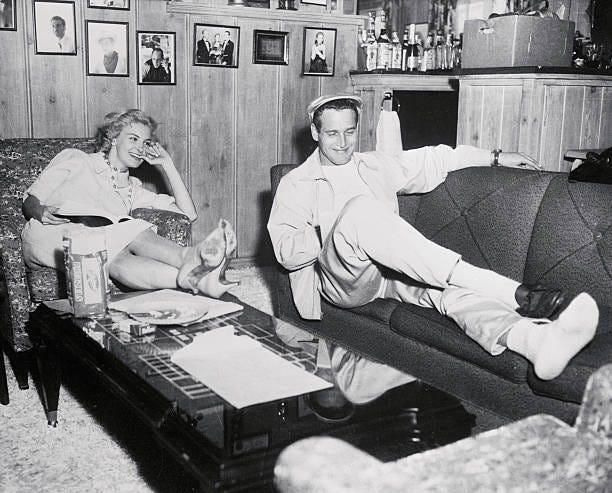
My parents’ bookshelves were windows to their interests. If one read every book on those shelves one could skip college entirely. Robert Stone jockeyed for space with Thomas Mann and Gibbon, Iris Murdoch snogged Anais Nin. Gore Vidal’s fat books owned a preponderance of real estate mid-shelf with my mother’s Oscar wedged somewhere in between. Victor Navasky and other political writers piled themselves next to my father’s bedside table, across from my mother’s Anthony Trollope and Agatha Christie, with Proust sinking again and again to the bottom of the pile. Much later, in a feeble attempt to rid myself of some of their paperbacks, I hauled a box out onto the lawn with a sign that said “Free” until several people pointed out that, mixed in with the dogeared, were inscribed first editions, or heartfelt notes from the authors. Sighing, I hauled the box back into the garage. Summer life in the Nook House felt both nurturing and chaotic. There were six children (and friends) at various times running in and out, especially early on. My mother ran things with an eccentric family of help, mostly women, mostly wonderful. We had a nanny who only rode a motorcycle, and had been a postwoman in Britain during the war. But my mother was the one who tended to know where everyone was, made the omelets, kept track of doctor’s appointments and got everyone where they were supposed to be. It only recently occurred to me that the reason my parents always tried to pack us off to boarding school was that they would have had an empty nest at a time when they sorely needed one. I was the one who would never leave. My husband and I bought the house in 2002 and re-peopled it with toddlers. My parents had decamped to my grandmother’s lovely old saltbox next door, connected by an impressive suspension over the not-very-wide river (one of my father’s more outrageous follies). It does feel a bit like living in a very funky museum. From the moment you go searching for a doorbell (an actual bell, brass, old-school cord that is hanging next to your head that no one thinks to look for) till the time you exit, you have a sense that you are somewhere that has always been deeply “utilized.” My father personally jammed every available inch of wall with the family photographs. We did try to paint the kitchen once, carefully removing each photograph from its bent and barely clinging nail. I don’t know how he did it, the plaster and lath could bust a railroad spike. Even at the height of my parents’ stardom, the house was protected only by a large wooden gate (generally open), and a tumbledown knee-high stone wall. Visitors, invited or not, would be greeted by a menagerie of overly friendly cats and dogs, including an Irish Wolfhound named Duffy (after the nanny), who was the size of a small pony. We frequently came home to find people snapping photos on the lawn or a slow trail of drivers blocking the driveway, craning their necks for a view of my father while he honked and cursed them from his VW at the back of the line. He and my mother always said the tree house was what made them buy the property. It was a flimsy perch in a giant maple with a lethal, ladder-like staircase. They would sneak away with beer and sherry, and sneak back in time to fire up the charcoal and shuck the corn. The Aspetuck river runs behind the house, and on summer evenings my parents would push off the stone dock in a yellow raft and head upstream for a moment of peace. The smaller dogs would insist on joining them, sometimes in the raft, sometimes running up and down the banks, barking. They had overlapping tastes regarding decor. My mother was guided by the chintzy charm of her own mother, while my father was happy to clad everything with barnwood and line the walls with snapshots of friends and a disturbing cast of early American portraits of somber children and grim adults. They were his chosen relatives. My parents shared a passion for antiques and vintage items, the quirkier the better. My mother and I once fell in love with a hideous lamp at an antiques show (Yes, it’s still here!) made from piano pedals, which we smuggled to the car, narrowly avoiding judgment from Martha Stewart who happened to arrive as we were leaving. My father had a penchant for garden statuary, cherubs and gargoyles, zaftig maidens with cornucopia. A giant outstretched hand stood outside the kitchen door, and he would insist that people place loose change in it “for the grandchildren’s college fund.” When my mother wanted to decorate a summer porch with wicker, my father would inevitably arrive home with a massive wooden chandelier painted gold, and insist that it must also look like an English pub. She was gracious to a fault. We have not exhausted their Cabinet of Curiosities quite yet, but the decision to release these loved and quirkily cultivated objects is deeply emotional for all of us I think. It’s not the conventionally desirable things I will miss, but the strange and absurd ones. They were orphans who found an appreciative and loving audience in the homes of two movie stars. The consolation lies in the fact that sending them out into the world means they retain their new and shiny provenance. I like to speculate about the future family of the mysterious collection of portraits that so captivated my parents who, by extension, will become, in some way, my distant relatives. In addition to decorating together, my parents relished other opportunities to collaborate, and did so as often as they could. There was no one our father would rather direct, and no one he revered as an actor more than my mother. Decades into their marriage they did the epistolary play “Love Letters” by A.R. Gurney several times. It’s a two person reading, a correspondence of unrequited love through a lifespan, and at a point, close to the end, it suddenly becomes evident that one of them has died. My parents only ever performed it with each other, and in the moments leading up to my mother’s fictional demise my father’s lower lip would start to tremble until, as he read the letter of condolence, he would be an absolute puddle. The first time it happened I went backstage and, flinging myself into his arms, became a puddle myself. “That was….” I said, “Overblown…” he said “...out of control.” He was grumpy. I asked Michael Cristofer, the director of this particular production, if those tears happened to my father every time. “Every single time,” he said. True love, I think, wants to hold hands and run towards the cliff together, but that seldom happens. Watching them in “Love Letters” I confirmed in my heart that he would jump the existential ship if he had to, to get out before she did, knowing full well that he could not bear it, and that’s just what happened. The entity which was “They” continues to pulse with life though. The lives they have touched in turn touch other lives. There was something inexorable about their relationship. It could not be helped, and though it might fray sometimes to gossamer, it held. You have to admire that.